
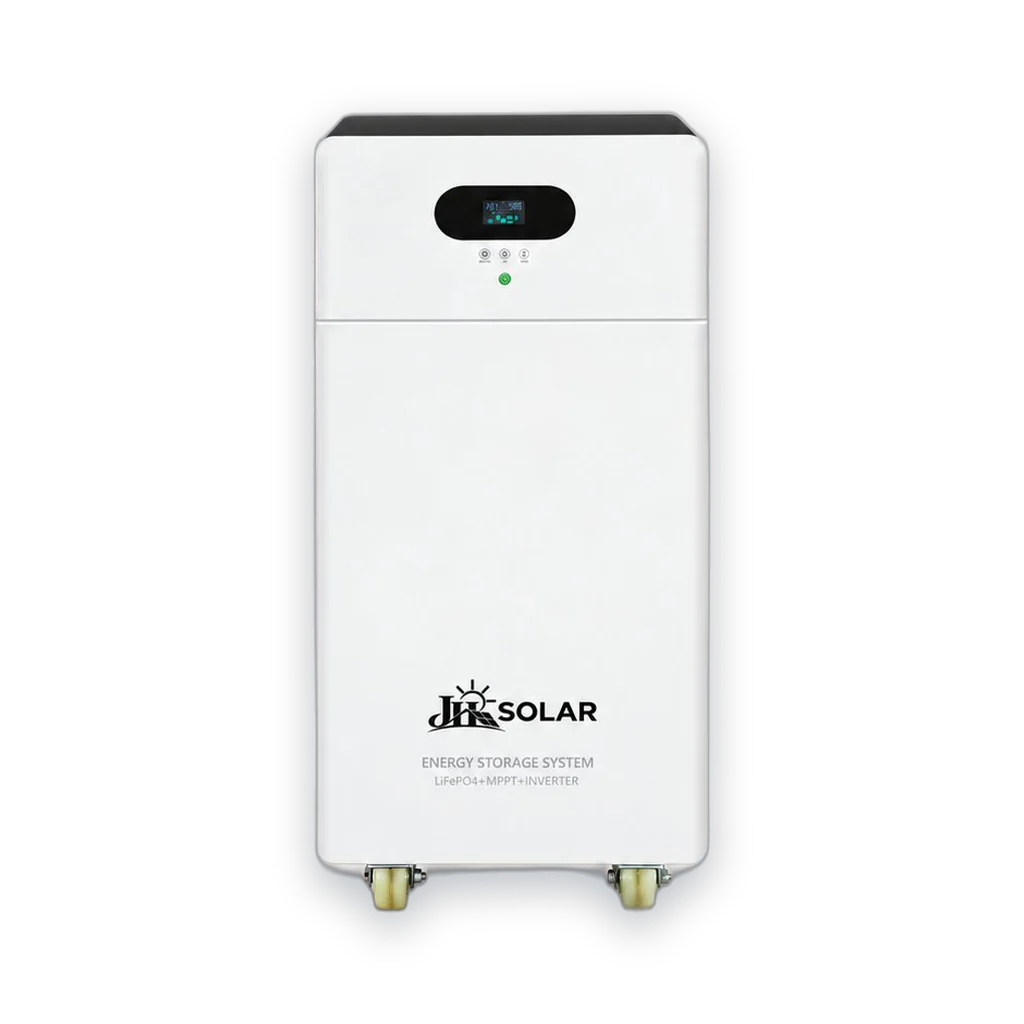
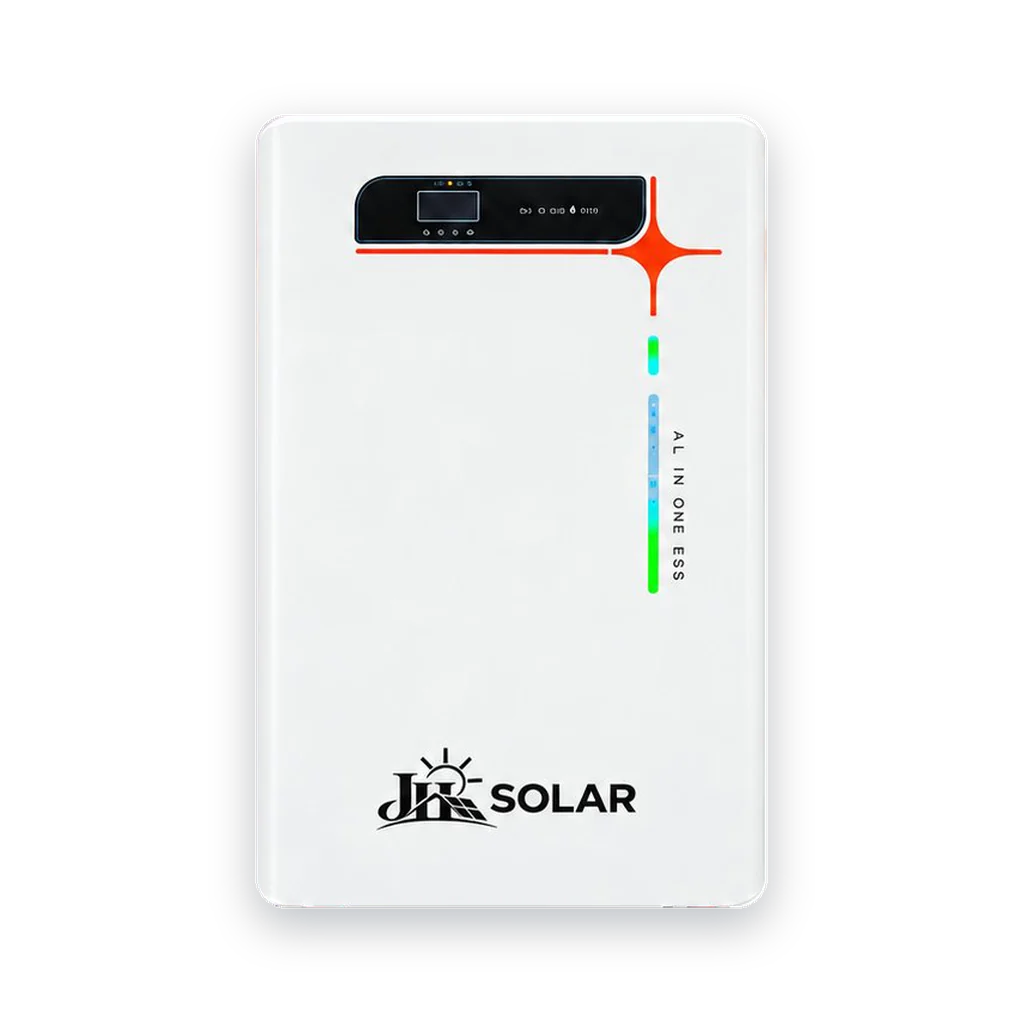
What JH Solar Offers: Two All-in-One Solar Systems
JH Solar is a solar brand for homes and small businesses in the Philippines. We offer two all-in-one systems, Version 1 and Version 2, and help you work out which one fits your daily use, if either does. Both units are rated and priced below, so you can compare them first. You may also see our name written as one word, JHSolar; it is the same brand.
What all-in-one means
An all-in-one unit puts the hybrid inverter and the battery in one cabinet. The inverter turns DC power from the panels and the battery into AC power for your outlets, and it manages charging from solar and from the grid. In a system built from separate parts, these are two or three boxes on a wall joined by heavy cables.
In an all-in-one, the main link between inverter and battery is made inside the cabinet, so the install is neater. It does not remove the rest of the system: you still need panels, mounting, PV cables, breakers, surge protection and grounding, all installed by a licensed electrician. The diagram shows how the parts connect.
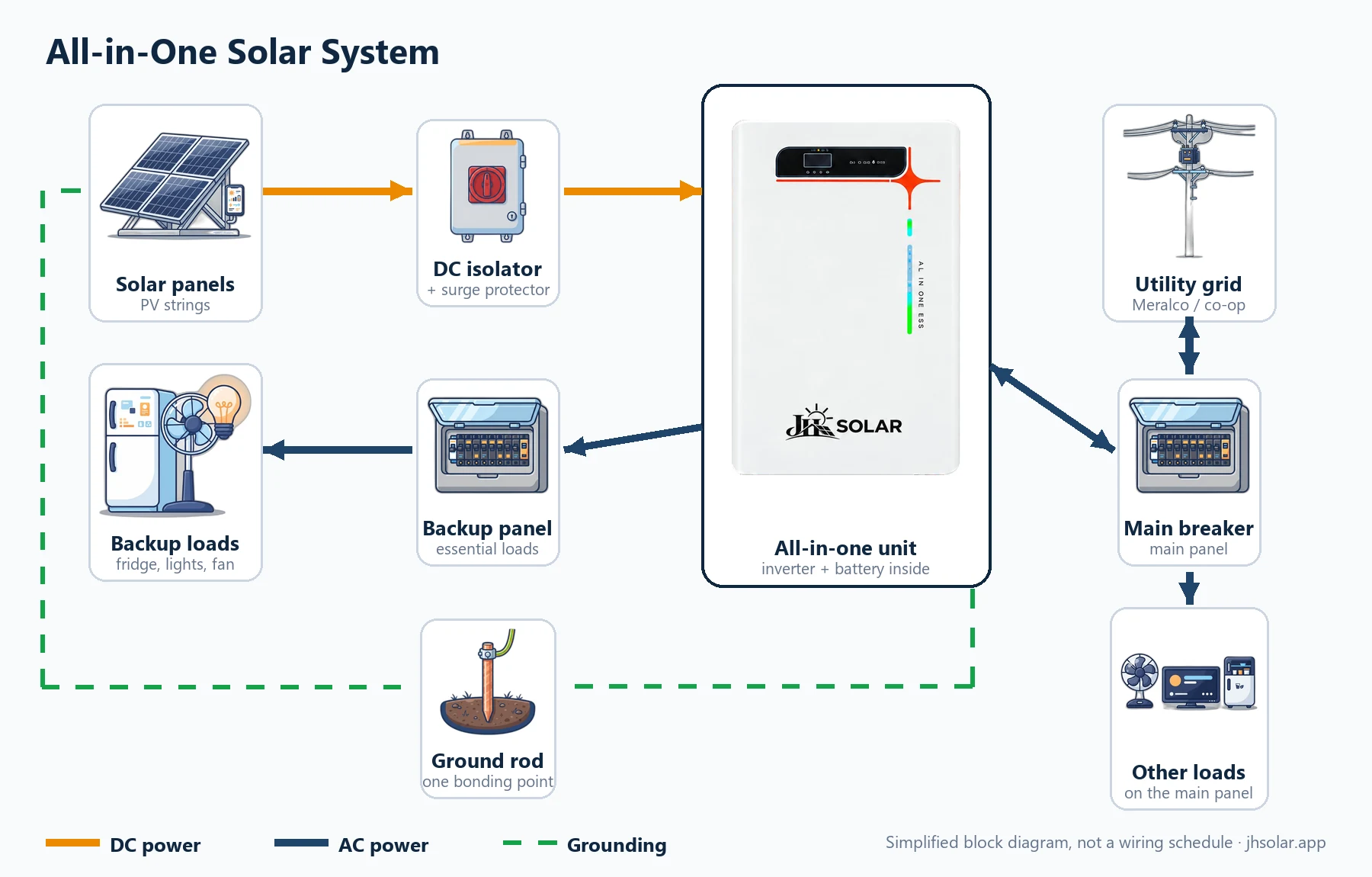
Solar panels connect through a DC isolator and surge protector to an all-in-one unit that holds the hybrid inverter and the battery in one cabinet. Utility power feeds its grid input through a breaker, and its backup output feeds the essential-loads panel.
- Benefits: one cabinet, a tidier wall, fewer site connections, and an inverter and battery chosen to work together.
- Trade-offs: a fault inside can affect the whole cabinet, adding battery later depends on the unit, and the cabinet is heavy, so it needs a solid, ventilated spot.
Version 1: the smaller package
Version 1 is rated for a 7 kW inverter (230 V AC, pure sine wave) and a 16.38 kWh LiFePO4 battery (51.2 V, 320 Ah). Its one MPPT solar input takes up to 4,480 W, so it works with up to 6 panels: 6 × 620 W is 3.72 kWp. The unit price is ₱120,000, unit only, and the warranty terms are written into your quote.
One honest limit: 4,480 W of solar input cannot fully refill 16.38 kWh in a short peak-sun window, so Version 1 suits smaller daily use and night backup. Read the full Version 1 specs and sizing page.
Version 2: the larger package
Version 2 is rated for an 11 kW inverter, a 15.36 kWh nominal LiFePO4 battery and two MPPT solar inputs of 5,500 W each, enough for 14 panels of 720 W (10.08 kWp). It has a 10-year hardware warranty; exact coverage is written into your quote. The unit price is ₱150,000, unit only. It rolls on casters and weighs about 160 kg. See the Version 2 product page for every rating.
Example only: 15.36 kWh × 0.80 usable × 0.90 efficiency ≈ 11.06 kWh to your AC loads, or roughly 11 hours at a steady 1 kW. Real backup time changes with your loads, the charge left in the battery and the weather, so treat this as math, not a promise.
| Item | Version 1 | Version 2 |
|---|---|---|
| Type | All-in-one: inverter and battery in one cabinet | All-in-one: inverter and battery in one cabinet |
| Solar panels | 6 × 620 W | 14 × 720 W |
| Array size | 3.72 kWp | 10.08 kWp |
| Inverter | 7 kW | 11 kW |
| Battery | 16.38 kWh nominal (51.2 V, 320 Ah) | 15.36 kWh nominal (51.2 V, 300 Ah) |
| Solar inputs | 1 MPPT, 4,480 W | 2 MPPT, 5,500 W each |
| Warranty | Terms written into your quote | 10-year hardware warranty; coverage in your quote |
| Unit price | ₱120,000 (unit only) | ₱150,000 (unit only) |
Unit only: panels, mounting, wiring, labor and permits are quoted after a site assessment. Array size = number of panels × panel watts.
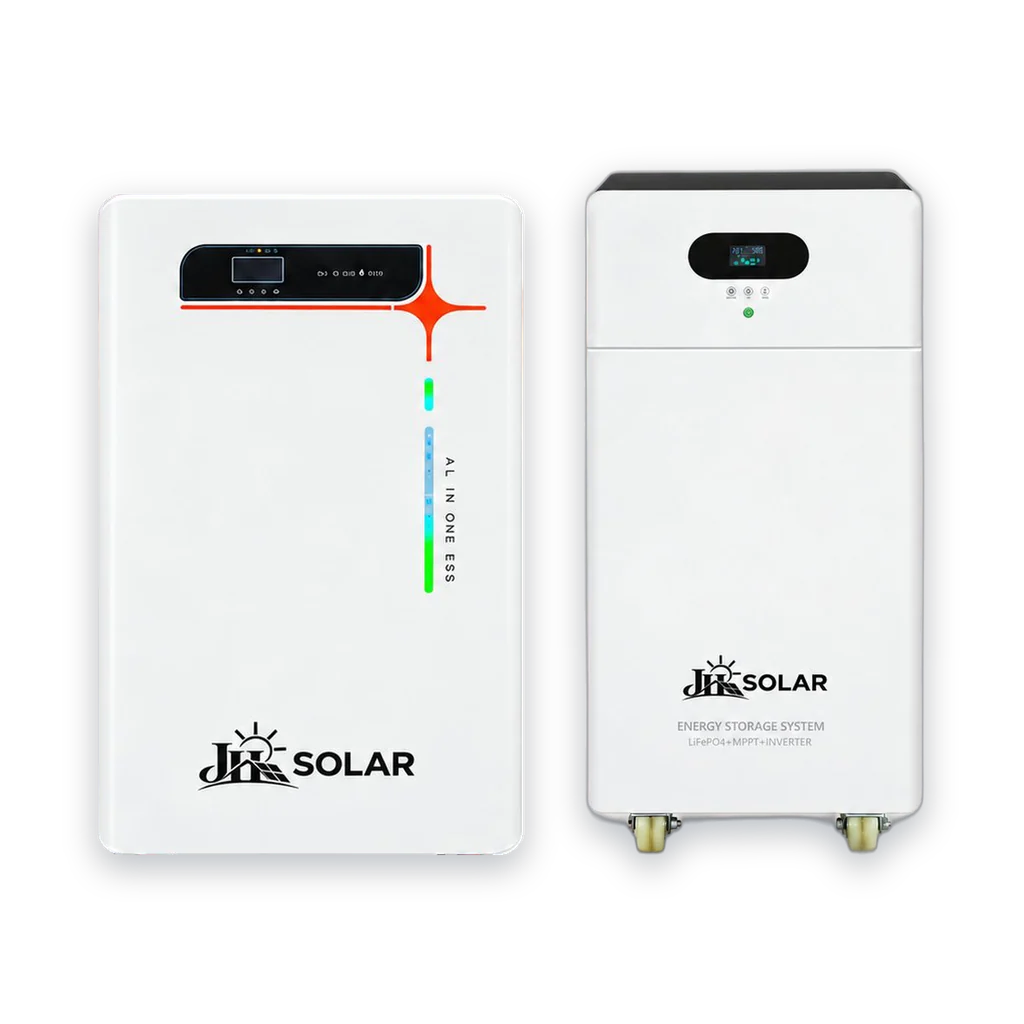
Both packages include:
- All-in-one unit (hybrid inverter and battery in one cabinet)
- Solar panels
- Mounting rails and roof hardware
- Electrical parts: PV cables, DC isolators and breakers, surge protection, AC breaker, grounding
- Labor: installation and commissioning
The unit price of each JH Solar version is listed above. The full system is quoted after a site assessment, because your roof, cable runs and loads change the parts list. You can compare Version 1 and Version 2 side by side, with sizing examples for each, before you get in touch.
Why Filipino Homes Look at Solar
People usually come to solar for one of three reasons: the monthly bill, brownouts, or the heat that keeps the aircon running. Each one points to a different setup.
Bills that change every month
Your rate per kWh is printed on your bill, and it changes from month to month. The Department of Energy electricity data page is a good place to follow the trend. Solar panels make power in the daytime, so the more of your use happens while the sun is up, the more of your own solar power you use directly.
Heat and aircon use
Hot afternoons are when aircon units, fans and refrigerators work hardest, and that is also when panels are producing. Panels do lose some output when they get very hot, so good airflow under the panels and honest sizing both matter.
Brownouts and backup power
If brownouts are your main worry, you need a battery. A grid-tied inverter without one shuts down during a brownout. This is called anti-islanding, and it protects the line workers fixing the grid. To keep lights, fans, the refrigerator and Wi-Fi running, you need a hybrid or all-in-one system. LiFePO4 (lithium iron phosphate) is the common chemistry for home solar batteries, and it handles deeper daily cycling than lead-acid.
Small businesses
If your shop, small office or food stall runs its main loads in the daytime, that pattern suits solar well. The questions are the same as for a home: how many kWh you use, what must keep running in a brownout, and whether the roof can carry the panels safely.
The limits of solar
Solar is not magic. It costs real money upfront, output drops on cloudy days and in the rainy season, and batteries wear with use. A good plan starts from your own numbers, and that includes any plan from JH Solar.
How Solar Computation Works in Three Steps
You do not need to be an engineer to size a system. Our free solar computation tool does the math in your browser, and the three steps below show what it is doing.
- Daily kWh: the kWh on your bill (or bill ÷ rate per kWh) ÷ days in the billing period, or appliances’ watts × hours ÷ 1,000. Example: 800 W × 8 h ÷ 1,000 = 6.4 kWh.
- Inverter and battery: the inverter, in kW, must cover the highest load running at the same time plus the start-up surge of motors such as aircon compressors and pumps. The battery, in kWh, is the backup energy you want ÷ (usable share × efficiency). Example: 6.4 ÷ (0.80 × 0.90) = 8.89 kWh nominal.
- Panels: daily kWh ÷ (peak sun hours × system factor) ÷ panel size, rounded up. Example: 10 ÷ (4 × 0.75) = 3.33 kWp; 3.33 ÷ 0.72 = 4.63, so 5 panels of 720 W.
The tool’s defaults (4 peak sun hours, a 75% system factor, 80% usable battery, 90% efficiency, 620 W panels and 25% inverter headroom) are assumptions you can change. Panel strings must also pass the inverter’s voltage and current limits, which an installer checks against the datasheets.
A calculator cannot see your roof. Shade from a neighbor’s house or a mango tree, the direction the roof faces and the length of the cable run all change the final design, so the result is a starting point for a conversation, not a parts list.
Which Solar Setup Fits Your Home?
There are three common ways to set up home solar. The right one depends on whether you need backup power, whether you want to export to the grid, and how much wiring you will leave to professionals. JH Solar systems are all-in-one hybrid units, so they belong in the “Hybrid or all-in-one” column of the table below.
Off-grid
An off-grid system is not connected to the utility at all. Panels charge a battery through a charge controller, and an inverter runs your loads. Small DC-side kits for a sari-sari store light or a bahay kubo are where careful DIY makes sense, with fuses, breakers and grounding. Our off-grid solar setup guide walks through a small kit.
Hybrid
A hybrid system uses the grid and a battery together. The inverter runs your home from solar first, charges the battery, and draws from the grid when needed; in a brownout it switches essential loads to the battery. The hybrid solar system diagram shows how the backup panel is wired.
Grid-tied
A grid-tied, or on-grid, system has no battery. It cuts the daytime bill and, with net metering, can export extra power to the utility, but it shuts off during a brownout. Read the on-grid solar diagram and net metering guide.
| Question | Off-grid | Hybrid or all-in-one | Grid-tied |
|---|---|---|---|
| Utility connection? | No | Yes | Yes |
| Battery? | Yes | Yes | No |
| Brownout power? | Yes | Yes, backup loads | No |
| Net metering? | No | With approval | With approval |
| Who wires it? | Small DC kits: careful DIY; larger: licensed electrician | Licensed electrician | Licensed electrician |
| Usual fit | Remote sites, small loads | Lower bill plus backup | Lower daytime bill |
A quick way to choose: if you mainly want a lower daytime bill and brownouts are rare where you live, a grid-tied system may be enough. If brownouts are common or you work from home, a hybrid or all-in-one system keeps your essentials running. If there is no grid line at all, go off-grid.
Free Solar Guides for Every Step
Every guide is written for Philippine homes and shows its sources and assumptions.
- Solar computationTurn your bill into kWh, panels, inverter and battery size.
- Solar setup diagramsRead a wiring diagram and pick off-grid, hybrid or grid-tied.
- Solar battery guideLiFePO4 vs lead-acid, usable kWh and safe placement.
- Solar panel priceWhat a full system costs and how to compare quotes.
- Solar panel installationSite survey, typhoon-ready mounting, permits and upkeep.
- Solar for airconSizing for 1HP to 2HP units.
- Power stationsWhen a portable unit is enough, and when it is not.
- Types of solar panelsMono, bifacial, TOPCon, flexible.
- Panel and battery brandsThe specs and warranty checks that matter.
- Choosing an installerQuestions to ask and red flags in quotes.
- Solar inverter guideHybrid, grid-tie and off-grid types, and sizing for surge loads.
- How solar panels workFrom sunlight to sockets, in plain words.
How to Get a JH Solar Quote
A quote from JH Solar is based on your real usage and your real roof, not on a one-size package. Here is how it works, from your first estimate to switch-on.
Step 1: Compute your setup
Run your bill or appliance list through the calculator for a starting size, with every assumption shown.
Step 2: Send your bill and location
Send a photo of your latest bill, your city or municipality, and the loads you want running in a brownout through the contact page. Before you take the photo, hide your name, address and Customer Account Number (CAN); we only need the kWh used, the billing period and the amount.
Step 3: Site assessment
We check your roof type and direction, shading, the main panel board, and where the cabinet and cables can go.
Step 4: Your written quote
The quote lists the version, panels, electrical parts, labor, price and warranty terms. Ask about anything unclear before you agree. Payment options: Bank transfer, GCash, Maya, Cash.
Step 5: Installation by licensed electricians
Licensed electrical practitioners install and commission the system under the Philippine Electrical Code. Net-metering permits follow if you want them.

Our official website is https://jhsolar.app. Before sending a bill or personal details to anyone using the JH Solar name, check that the message points back here.
What Affects the Price of a Solar System
We list unit prices, not whole-system prices, because homes with the same bill can need different parts. These factors move the price of any system, from JH Solar or another provider.
| Factor | Why it matters | What to tell us |
|---|---|---|
| Array size (kWp) | More panels, rails and labor | Monthly kWh |
| Battery (kWh) | More storage costs more | Brownout loads and hours |
| Inverter (kW) | Large motor loads need more power and surge room | Aircon units and pumps |
| Roof and mounting | Roof type, height and wind exposure change the hardware and labor | Roof type and photos |
| Cable runs | Long runs from roof to cabinet to panel board need more cable | Where the panel board sits |
| Electrical upgrades | An old panel board or missing grounding may need work first | A photo of your panel board |
| Permits and net metering | Permits, inspection and utility charges add to the total | Whether you want to export |
For market ranges, see our guide to solar panel prices in the Philippines. Compare quotes on the same terms: kWp, usable battery kWh, inverter kW, brands and warranty. When you ask “magkano,” the answer is only clear once every line is written down.
Be careful with a quote that is far cheaper than the rest and does not explain why. Ask which brands are included, whether the battery figure is usable or nominal, and whether permits, grounding and labor are in the total.
Solar in the Philippines: Sun, Storms and Net Metering
These are the local points JH Solar looks at for every home we assess.
Peak sun hours
Peak sun hours are the day’s sunlight counted as hours of full-strength sun. In the Philippines they are typically about 3.5 to 5 a day, depending on the place and the season. Look up your city on the Global Solar Atlas and use that number in the calculator instead of our default.
Rainy season and typhoons
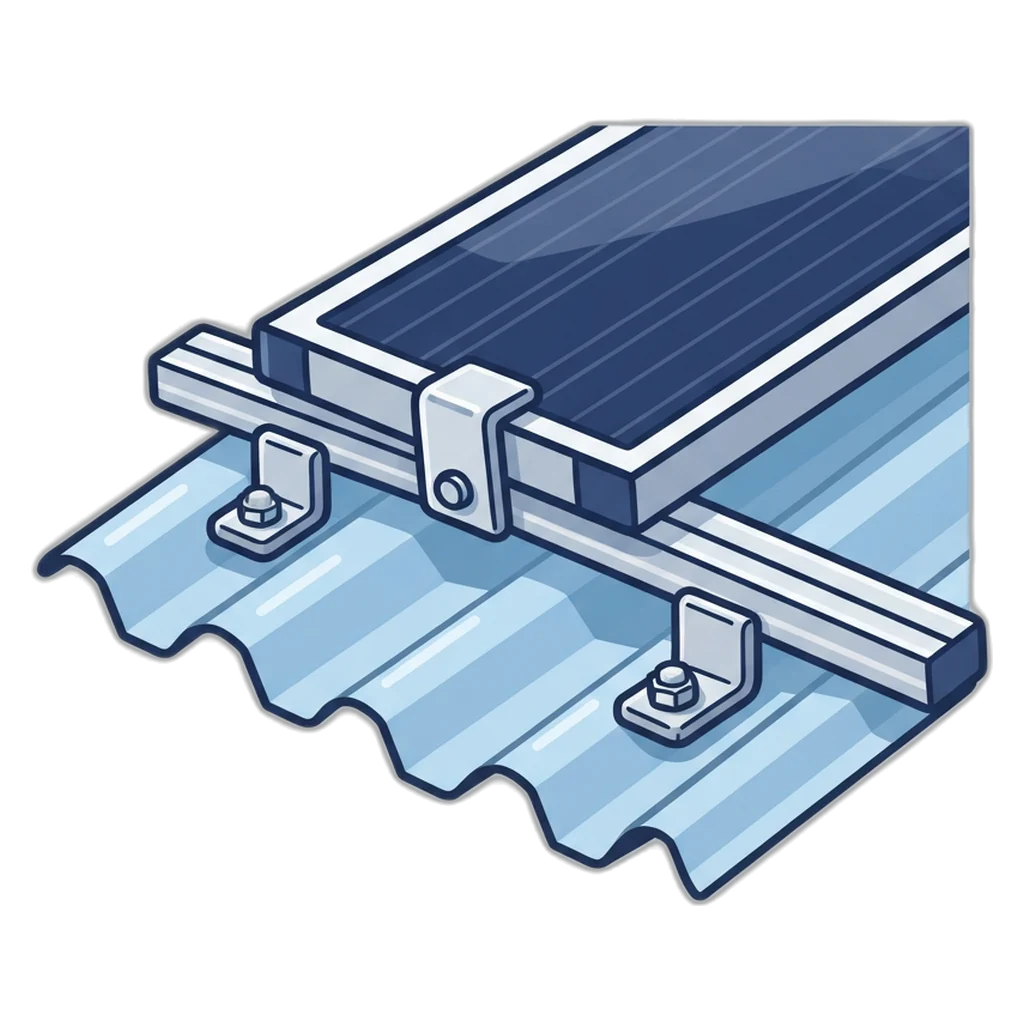
Output drops on overcast days, so size for an average day and decide in advance which loads you will cut when the weather turns. Mounting must suit the wind loads on your roof, with proper rails, clamps and roof attachments. Follow the PAGASA tropical cyclone signals and have the panels, rails and cables inspected after any strong storm.
Net metering basics
Net metering credits solar power you export to the utility. According to the Meralco net metering FAQ, it is for systems up to 100 kW, with an ERC Certificate of Compliance and a net-metering agreement among the papers. Cooperatives handle it for their members. Our step-by-step net metering guide for the Philippines covers the steps and fees.
On your phone
- Photograph the whole bill, including the kWh used and the billing period.
- The calculator runs in your phone browser; swipe tables sideways to see every column.
Safety and Electrical Reminders
- Never open the cabinet: it holds a charged battery and high DC voltage even with breakers off.
- Panels are live whenever light hits them. Never plug or unplug PV connectors under load; turn off the DC isolator first.
- Grid-tied, AC panel board and net-metering work is for an RME or PEE under the Philippine Electrical Code, published by the IIEE.
- Keep the cabinet in a shaded, ventilated and dry place, away from children and anything that burns easily.
- On the solar side, use breakers and surge protection rated for DC; AC parts are not a substitute.
- Clean panels from the ground where you can. Roof work needs a harness and a second person.
- After a typhoon or flood, keep the system off until an electrician checks it.
Solar panels make DC power whenever light hits them, and batteries hold enough energy to start a fire if they are shorted. Work on the grid side, the AC panel board or a net-metered system belongs to a licensed electrical practitioner following the Philippine Electrical Code. Our numbers are estimates, not a design or a quote.
Frequently Asked Questions
What is JH Solar?
JH Solar is a Philippine solar brand that offers two all-in-one solar systems, Version 1 and Version 2, for homes and small businesses. Each one has the hybrid inverter and the battery in one cabinet. This site also has free guides on solar computation, setup diagrams, batteries, prices and installation.
Which areas do you cover?
Tell us your city or municipality when you ask for a quote, and we will confirm whether we cover your area. Coverage depends on the location and on access for the site assessment and the installation, so we answer case by case instead of posting a list that may change.
Are both versions really all-in-one units?
Yes. Version 1 and Version 2 are both all-in-one units, which means the hybrid inverter and the battery sit together in one cabinet. You still need solar panels, mounting rails, PV cables, breakers, surge protection and grounding, and those come as part of the package and the installation.
Will the system keep my lights on during a brownout?
Both versions hold a battery in the cabinet, so loads wired to the backup output keep running during a brownout until the battery runs low. Version 1 is rated for a 16.38 kWh nominal battery and Version 2 for 15.36 kWh. A grid-tied-only system with no battery shuts down in a brownout.
How do I order a JH Solar system?
Start with the solar computation tool to get a rough size. Then send your latest electric bill, your location and the loads you want backed up through the contact page. We arrange a site assessment, send a written quote, and once you agree, licensed electricians install and commission the system.
What warranty comes with each version?
Version 2 comes with a 10-year hardware warranty; the exact coverage is written into your quote. For Version 1, the warranty terms are written into your quote. Solar panels and other parts carry their own warranties, so read each one before you sign.
Start Your Solar Plan With JH Solar
JH Solar offers two all-in-one systems and free guides so you can decide with real numbers. Compute your daily kWh, decide whether you need backup, export or both, and compare Version 1 and Version 2 against that need. Then send your bill and location for a site assessment and a written quote. Whatever you choose, leave the grid-side and AC wiring to licensed electricians.
Ready to size your solar setup?
Run the free calculator, then ask for a site assessment and a written quote.
Related Guides
- JH Solar ProductsOur two all-in-one units, side by side.
- Solar ComputationTurn your electric bill into a system size in a few taps.
- Solar Setup DiagramRead any solar diagram and pick the setup that fits you.
- Solar Battery GuideHow much battery you need for nights and brownouts.
- Solar Panel InstallationWhat happens on install day, and what comes before it.
- Solar FAQShort answers to the questions we hear most.