
Solar Inverter Guide: Types, MPPT, Sizing and What to Check
Last checked · JH Solar guide
A solar inverter is the box that turns the DC power from your panels into the AC power your outlets, aircon and ref use. It is the brain of a solar system: it decides where the energy goes, protects the parts and tells you what is happening through its screen or app.
This guide explains the main inverter types, MPPT and charge controllers, how to size an inverter for surge loads, the PV input limits that matter, and what to check before you buy. Every number is a labeled example with the formula shown or a JH Solar rated figure.
What a Solar Inverter Does
Solar panels make direct current (DC). Your home runs on alternating current (AC) from Meralco or your electric cooperative. The solar inverter converts one into the other and matches the grid’s voltage and frequency so the power can flow into your house wiring.
A hybrid inverter does more. It also charges and discharges a battery, decides when to use solar, battery or grid power, and switches your backup loads to the battery when a brownout hits. In off-grid kits the inverter runs alone and makes its own AC with no grid at all. The US Department of Energy’s guide to inverters and grid services explains these roles in more depth.
Why people search for an inverter for solar panel setups
Most people are planning a new system, puzzling over a model named in a quote, or fixing an inverter that trips when the aircon starts. All three come back to the same basics: type, size and input limits.
Types of Solar Inverter Compared
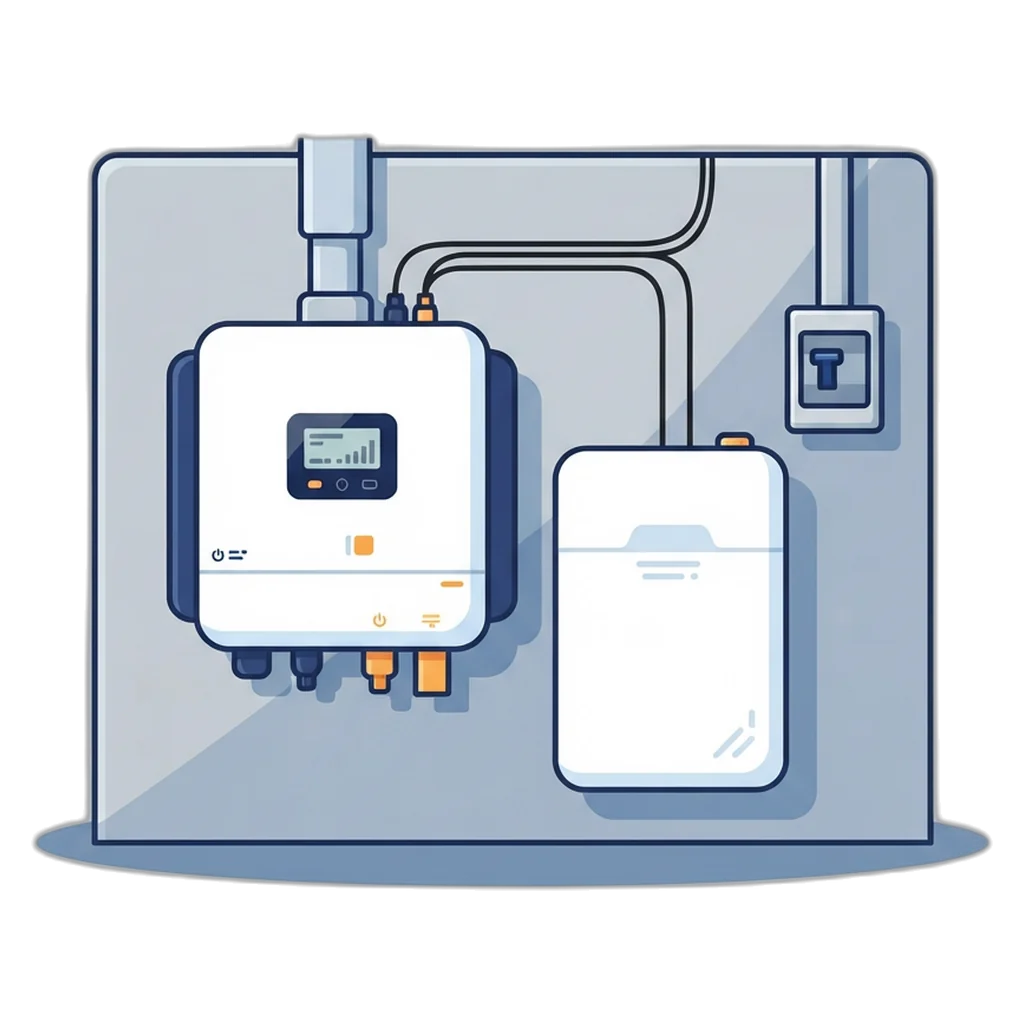
Every solar inverter falls into one of a few families. The right one depends on whether you want backup during brownouts, whether you will export to the grid, and how much space and budget you have.
| Type | Works with a battery? | Power in a brownout? | Good fit for | Watch out for |
|---|---|---|---|---|
| Grid-tie (string) inverter | No. | No: shuts down for safety (anti-islanding). | Cutting daytime bills, often with net metering. | No backup at all without adding storage later. |
| Hybrid inverter | Yes, built-in charging. | Yes, for loads on the backup circuit. | Homes that want lower bills and brownout backup. | Battery must be on the inverter’s compatibility list. |
| Off-grid (standalone) inverter | Yes, it needs one. | Not connected to the grid, so it runs on its own. | Farms, remote homes, small DIY kits. | Battery and panels must cover every load. |
| Microinverters | Not directly; needs a separate battery system. | No, like other grid-tie units. | Shaded or split roofs with panels facing different ways. | Many small units on the roof to service. |
| All-in-one unit | Yes: hybrid inverter and battery in one cabinet. | Yes, for loads on the backup circuit. | Homes that want matched parts and a tidy install. | Expansion depends on what the maker allows. |
General comparison. Features vary by model, so check the datasheet and manual of the exact unit.
The grid-tie and hybrid families are drawn out step by step in our hybrid solar system diagram, which shows where the inverter, battery, backup panel and grid meter sit. If you want a small battery kit you can wire on the DC side yourself, the off-grid solar setup guide covers the parts and the fuse order.
Where all-in-one units fit
An all-in-one unit matches a hybrid inverter and battery in one cabinet: one screen, one app, fewer cables, but less freedom to mix brands later. JH Solar sells two systems built this way, Version 1 and Version 2.
MPPT vs PWM Charge Controllers
A charge controller sits between the panels and the battery and stops the battery from overcharging. Hybrid and off-grid inverters have one built in; small DIY kits often use a separate box. There are two main kinds.
PWM (pulse width modulation) connects the panels almost straight to the battery and switches them on and off to control charging. The panel is pulled down to battery voltage, so some of its power is wasted. MPPT (maximum power point tracking) keeps hunting for the voltage where the panels give the most power, then converts it down to what the battery needs.
| Feature | MPPT | PWM |
|---|---|---|
| How it works | Tracks the panels’ best operating point and converts the voltage. | Switches the panel on and off at battery voltage. |
| Panel voltage | Panel strings can run at a higher voltage than the battery. | Panel voltage must closely match the battery. |
| Energy harvest | Higher, especially when panels are hot or the battery is low. | Lower; part of the panel’s power is not used. |
| Cost | Higher. | Lower. |
| Good fit for | Home systems and anything beyond a small kit. | Very small 12 V kits on a tight budget. |
Inside a hybrid or off-grid inverter, the built-in controller is almost always MPPT. Check the datasheet for the number of trackers.
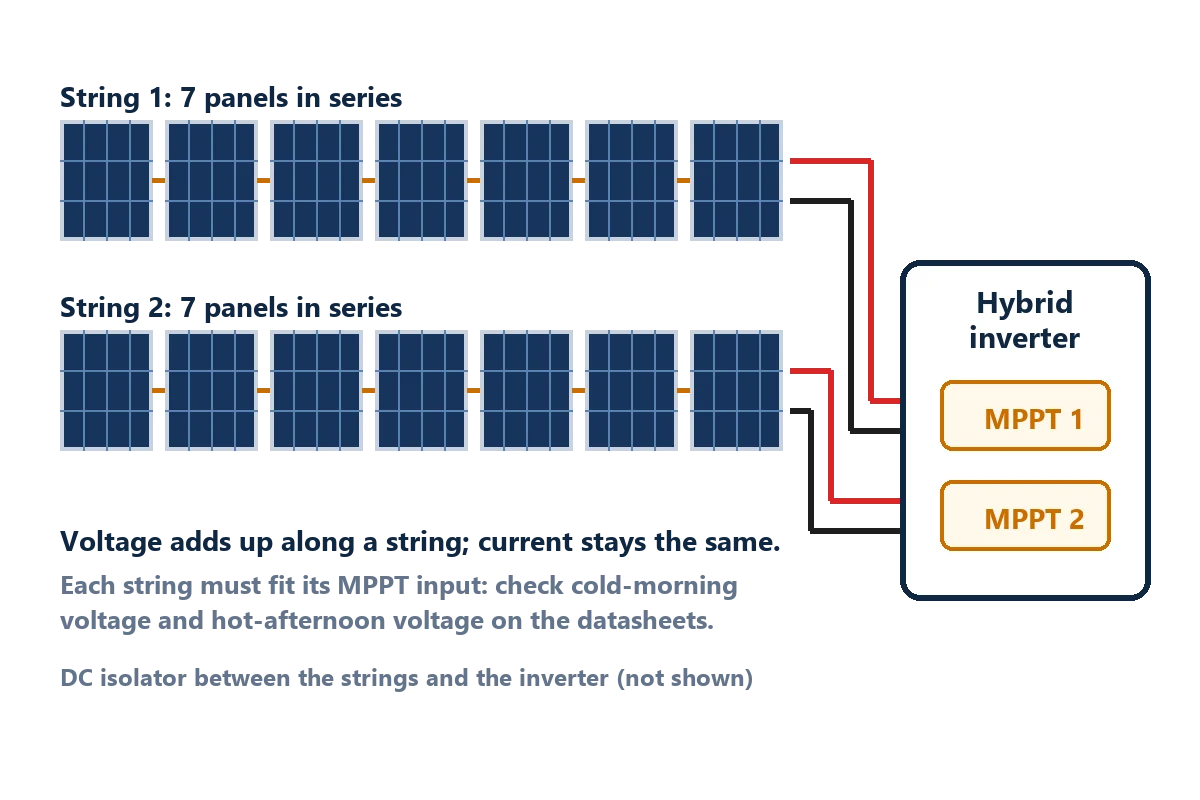
Inverters often list two or more MPPT trackers. Each tracker handles its own string, so panels on two roof faces, or one shaded string and one sunny string, do not drag each other down.
Pure Sine vs Modified Sine Wave
The grid gives a smooth, rounded wave. A pure sine wave inverter copies that shape, so every appliance runs as it does on Meralco power. A modified sine wave inverter makes a stepped, blocky wave that is cheaper to build.
Motors, compressors, inverter-type aircons, refs and some chargers can run hot, buzz or fail on a modified wave. Home hybrid and grid-tie units are pure sine; modified sine shows up mainly in cheap small off-grid inverters.
How to Size a Solar Inverter
Sizing a solar inverter is about power at one moment (kW), not energy over the day (kWh). The battery sets how long you can run; the inverter sets how much you can run at once. Three numbers matter.
- Continuous kW: add up the watts of every load that may run at the same time.
- Surge: motors and compressors (aircon, ref, water pump, washing machine) draw much more than their running watts for a second or two when they start. The inverter’s surge rating must cover the biggest one.
- Headroom: add a margin so the unit is not running flat out. Our calculator uses 25% by default.
| Load (example) | Running watts |
|---|---|
| Aircon | 800 W |
| Refrigerator | 150 W |
| Two electric fans | 100 W |
| TV | 100 W |
| LED lights | 50 W |
| Total running at once | 1,200 W |
| With 25% headroom | 1,200 × 1.25 = 1,500 W = 1.5 kW |
Example wattages only. Read the labels on your own appliances. The aircon and ref also need start-up surge, which the inverter’s surge rating must cover.
Example: in the table, a 1.5 kW solar inverter covers the running load with margin. Now check surge: if the aircon and the ref may start at the same moment, their start-up draw is added on top. Choose a unit whose surge rating clears that, or stagger the start-ups. An inverter-type aircon starts more gently than an older fixed-speed unit.
You can do all of this in a few taps when you size the inverter with our solar computation tool, where the headroom is one of the inputs you can change.
PV Input Limits: Voltage, Current and MPPT Windows
The panel side of a solar inverter has hard limits, and this is where most DIY mistakes happen.
| Datasheet line | What it means | What to check |
|---|---|---|
| Max DC input voltage | The highest voltage the input can survive. | String Voc on the coldest morning must stay below it. |
| MPPT voltage range | The window where the tracker works well. | String Vmp on a hot afternoon must stay inside it. |
| Max input current per MPPT | The current each tracker can use. | Panel current (and Isc) must fit the limit. |
| Number of MPPTs | How many separate strings it can track. | Enough trackers for your roof faces and shade. |
| Max PV input power | The panel power the unit accepts. | Total panel watts per tracker within the limit. |
Use the exact panel and inverter datasheets. Going over the maximum DC voltage can damage the inverter.
The cold Voc and hot Vmp check, simply
Panel voltage moves with temperature. On a cool, clear morning the open-circuit voltage (Voc) rises, so the string’s highest voltage happens then. On a hot afternoon the working voltage (Vmp) drops. Your installer uses the temperature coefficient on the panel datasheet to work out both.
Example (made-up datasheet numbers): a panel with a Voc of 50 V in a string of 10 gives 50 × 10 = 500 V at standard test conditions. On a cool morning it rises above that, so the inverter’s maximum DC voltage needs clear room above 500 V. On a hot afternoon the string’s Vmp falls, and it must stay above the bottom of the MPPT window or the tracker stops working well.
Example: JH Solar Version 1 and Version 2
Version 1 has one MPPT rated 4,480 W, with a 60–140 V tracking window and a 180 V maximum PV voltage. With our 620 W panel (Voc 48.6 V, Vmp 41.3 V): Example: 3 in series = 145.8 V Voc, which leaves room below 180 V for a cool morning, and 123.9 V Vmp, inside the window. Four in series would be 194.4 V, over the cap. So strings stop at 3 panels, and the package wires 6 panels as two strings of 3 (3.72 kWp). The JH Solar Version 1 specs page has the full stringing notes.
Version 2 is rated for 2 MPPT inputs of 5,500 W each and up to 500 V. The package uses 14 panels of 720 W. Example: 14 ÷ 2 = 7 panels per tracker, and 7 × 720 W = 5.04 kWp per tracker by power only. The strings must still pass the voltage and current limits above, which is part of the installer’s design.
Single-Phase Homes in the Philippines
Most houses here are on single-phase service, so a single-phase inverter is the usual match. Some larger businesses and buildings use three-phase power and need a three-phase unit or a set designed to work together.
The inverter must also be set to the local grid standard (60 Hz in the Philippines). Imported units sometimes ship with another country’s settings, so ask the installer to confirm them at commissioning.
Efficiency, Heat and Placement
Every conversion loses a little energy as heat, and efficiency changes with load: a unit idling at a tiny fraction of its rating, or running flat out, does less well than one in the middle.
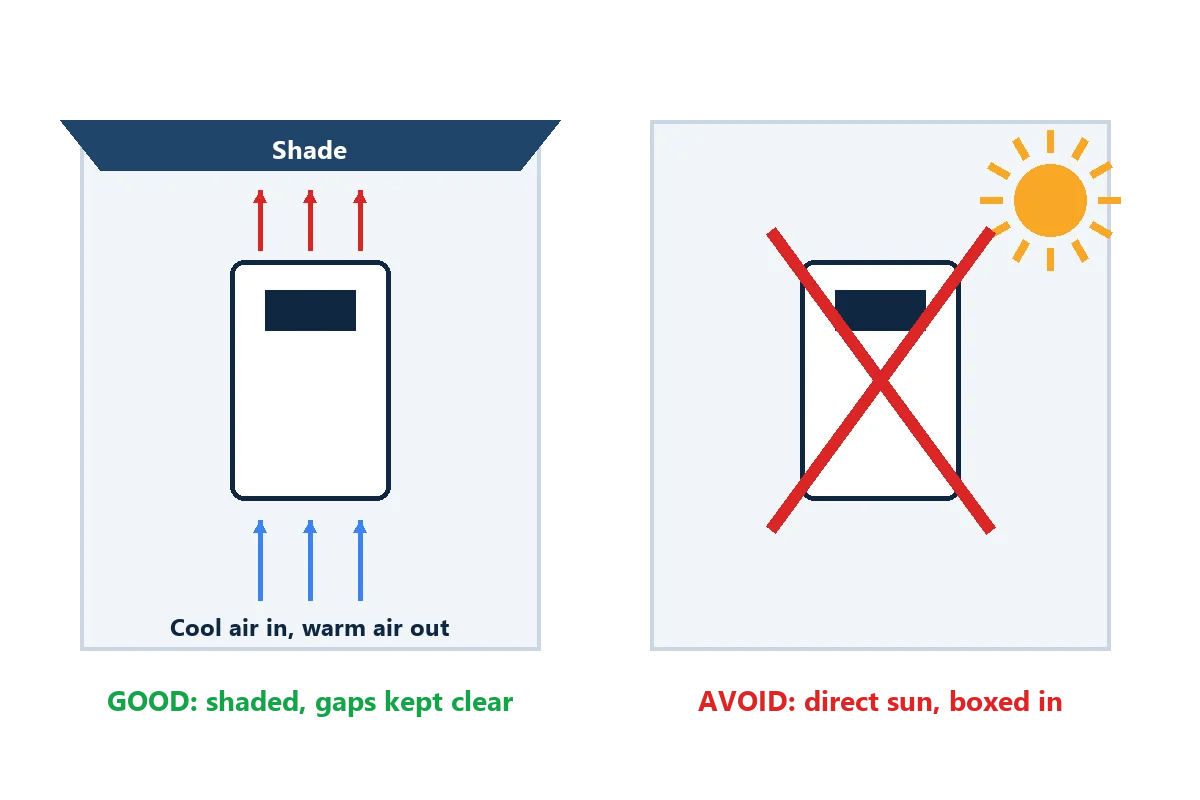
Heat is the bigger enemy. When the inside gets too hot, most inverters derate: they cut their output to protect themselves, often on the sunniest afternoons when you want power most. Shade on the panels lowers output too, and with a single string it can pull down the whole string.
- Mount it out of direct sun and rain, ideally on a shaded wall or in a ventilated utility area.
- Leave the clearances the manual asks for above, below and beside the unit.
- Keep vents and fans free of dust, cobwebs and stored boxes.
On Your Phone: Monitoring Apps
Most modern units connect to a monitoring app over Wi-Fi or a data stick. It shows solar input, home load, battery charge and grid use, with a history you can scroll back through.
- Check the daily curve. A smooth hump on sunny days is normal. A sudden flat top or dip at the same hour each day can point to clipping, heat derating or shade.
- Turn on alerts. Fault and low-battery notifications reach you even when you are out.
- Screenshot fault codes and send them to your installer by chat; it speeds up support.
- Keep the router on backup if you want updates during a brownout.
Warranty and Service Questions
A solar inverter works hard every day, so after-sales support matters as much as the spec sheet. Before you sign, ask the seller:
- How long is the warranty, and does it cover parts only, or parts and labor?
- Who handles claims: the local distributor, the installer or the overseas maker?
- Is there a service center or spare unit in the Philippines, and how long does a swap take?
- Does the warranty need registration or an approved installer?
Brand reputation and local support go hand in hand. Our guide to choosing solar panel and inverter brands lists the specs and warranty checks that separate a solid product from a risky one.
What Affects Solar Inverter Price
We list no peso figures here because prices change often. These are the main things that move a solar inverter price up or down:
- Power rating. More kW and a higher surge rating cost more.
- Type. A hybrid inverter usually costs more than a grid-tie unit of the same kW, because it adds battery charging and backup switching.
- Trackers and inputs. More MPPTs, higher PV input limits and a generator input add cost.
- Brand, warranty and local service. Longer terms and a real service center are worth paying for.
- Features. Parallel operation, monitoring, and battery communication all affect price.
- Installation. DC isolators, breakers, surge protection, cables and labor belong in the real cost.
Installation Basics
Fitting a solar inverter to your home wiring is a job for a licensed electrician: a registered master electrician (RME) or a professional electrical engineer (PEE). The Philippine Electrical Code is published by the Institute of Integrated Electrical Engineers (IIEE), and a good installer will follow it. Expect these parts around the inverter:
- DC isolator between the panels and the inverter, so the PV side can be switched off for service.
- Battery fuse or breaker close to the battery terminal.
- AC breakers on the grid input and on the backup output, sized for the cables.
- Surge protection on the DC and AC sides, useful in a country with frequent lightning.
- Grounding of the inverter, mounting frame and panel frames to a proper earth.
Brownouts, Heat and Typhoons: The Philippine Context
Brownouts are the main reason Filipino families choose a hybrid solar inverter over a grid-tie one. A grid-tie inverter shuts down when the grid fails, even on a sunny day, so it gives no backup. A hybrid or all-in-one unit with a battery keeps your chosen circuits running.
If you want to export daytime power, net metering is handled by Meralco or your electric cooperative under RA 9513. The steps, documents and meter work are covered in our on-grid solar system and net metering guide. Check the current requirements with your utility, as of October 2026.
Heat and humidity shorten the life of electronics, so placement matters more here. Before a storm, follow the PAGASA tropical cyclone wind signals, charge the battery while you can, and keep the unit above any flood line.
Safety and Electrical Reminders
- Two sources of power. An inverter can stay live from the panels or the battery even when the grid is off. Follow the full shutdown order in the manual before anyone opens it.
- DC arcs do not stop on their own. Never pull a PV connector under load; open the DC isolator first.
- Respect the input limits. Never connect a string that may exceed the maximum DC voltage or current, even for a quick test.
- Ground everything. Inverter, frames and mounting rails need a proper earth connection.
- After a flood, hands off. Do not restart an inverter that has been wet; call your installer.
- Licensed hands only on AC. Grid and house-wiring connections are for an RME or PEE, not DIY.
Solar panels make DC power whenever light hits them, and batteries hold enough energy to start a fire if they are shorted. Work on the grid side, the AC panel board or a net-metered system belongs to a licensed electrical practitioner following the Philippine Electrical Code. Our numbers are estimates, not a design or a quote.
Frequently Asked Questions
Is an MPPT charge controller worth paying more for than a PWM one?
For most home systems, yes. MPPT lets you use higher-voltage panel strings and harvests more energy, especially when panels run hot or the battery is low. PWM still makes sense for a very small 12 V kit where the panel voltage already matches the battery and the budget is tight.
Can I connect more solar panels than my inverter’s rated kW?
Many inverters allow some extra panel power on the DC side, but only up to the limit printed on the datasheet. On the sunniest hours the extra output is simply clipped. The voltage and current limits are never flexible: a string that goes over them can damage the unit and void the warranty.
Why does my inverter hum or run its fan loudly?
A soft hum and a fan that speeds up under heavy load or on hot afternoons are normal. Loud buzzing, clicking that repeats, a burning smell or a hot case are not. In that case, switch the system off as the manual describes, keep people away and call your installer.
How long does a home inverter usually last?
There is no fixed lifespan. Heat, dust, humidity, how hard the unit works and build quality all play a part, and the warranty term is the clearest sign of what the maker expects. Keeping the unit shaded, ventilated and inside its rating is the best thing you can do for it.
Can two inverters run together to give more power?
Only if the model is designed for parallel operation. Usually the units must be the same model with matching firmware, linked by the maker’s communication cable and set up in the menu. Mixing brands or wiring outputs together without that support can damage both units, so leave it to your installer.
Do I need a separate charge controller with a hybrid inverter?
Usually not. A hybrid inverter has one or more built-in MPPT trackers that charge the battery from the panels. You only add a separate controller when you couple an extra array straight to the battery, and then it must match the battery voltage and the system’s charge settings.
Conclusion: Pick the Type, Size It, Check the Limits
A solar inverter turns panel DC into home AC, and a hybrid model also runs your battery and brownout backup. Start with the type that matches your goal, size it from the loads you run at once plus surge and headroom, and check that every panel string fits the PV input limits.
Choose a pure sine unit with MPPT, place it in shade with good airflow, ask hard questions about warranty and local service, and let a licensed electrician connect it. With those steps, your solar inverter can serve your home well through brownouts, hot summers and typhoon season.
Find the inverter size your home needs
List the loads you run at once, add headroom and see the inverter, battery and panel sizes, then ask JH Solar for a site assessment.
Related Guides
- JH Solar HomeStart here: JH Solar systems and every guide on one page.
- Solar ComputationTurn your electric bill into a system size in a few taps.
- JH Solar ProductsOur two all-in-one units, side by side.
- Solar Battery GuideHow much battery you need for nights and brownouts.
- Solar Panel for AirconRun your aircon on solar: panels, battery and inverter.