
How Solar Panels Work: Solar Energy Explained Simply
Last checked · JH Solar guide
How solar panels work is simpler than it looks. Sunlight hits special silicon cells, the cells push tiny charges called electrons through a wire, and that flow is electricity. The rest of a solar system exists to make that power safe and useful in your home.
This beginner guide explains solar energy in plain words for Filipino homeowners. You will learn what changes a panel’s output, what a typical day looks like on a home system, the difference between kW and kWh, and where the inverter and battery fit. No physics degree needed.
How solar panels work: the short answer
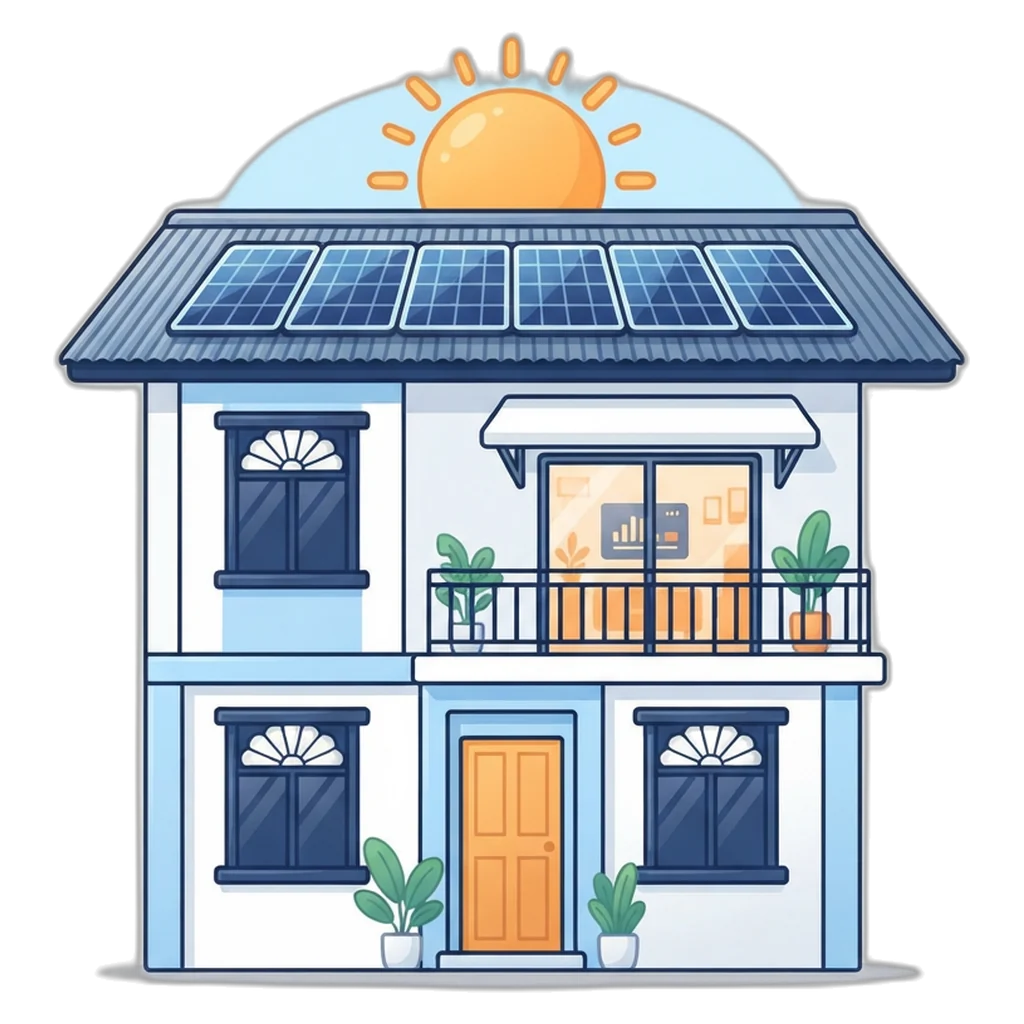
Here is how solar panels work in four lines. Light from the sun lands on a panel. Each cell inside turns part of that light into direct current (DC) electricity. An inverter changes the DC into the alternating current (AC) your outlets use. Whatever your home does not use right away goes to a battery, back to the grid, or is not produced at all.
People search for how solar panels work to cut a rising bill, to beat brownouts, or to understand a quote full of words like kWp, MPPT and hybrid before they sign. This page gives you the foundation for all three.
What is solar energy?
Solar energy is the energy carried by sunlight. The sun sends it out as light and heat, and a small share reaches the Earth’s surface, where it grows plants and drives the weather. Solar panels turn a slice of it straight into electricity, with no fuel, no moving parts and no noise.
Solar thermal systems use sunlight to heat water. Solar photovoltaic (PV) systems turn light into electricity, and they are what people mean by solar panels on a roof. For a science primer, see the US Department of Energy’s photovoltaic basics. The rest of this guide is about PV.
How a solar cell makes electricity
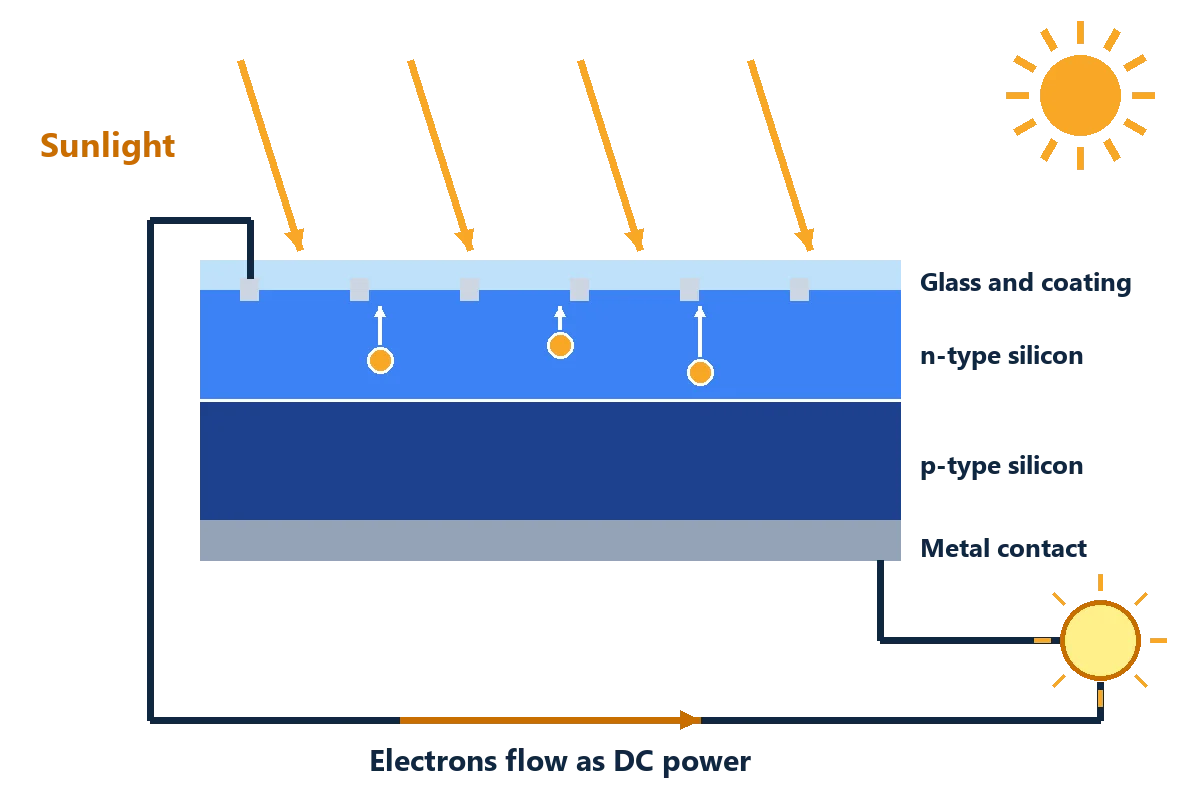
To understand how solar panels work, start with one cell: a palm-sized square of silicon, the material used in computer chips. Makers treat two layers of it so one has extra electrons and the other has room for them. Where the layers meet, a built-in electric field forms.
The photovoltaic effect in simple words
Light comes in tiny packets of energy called photons. When a photon hits the silicon, it knocks an electron loose, and the built-in field pushes it one way. Thin metal lines collect the electrons and send them around your circuit and back into the cell. That flow is an electric current. This is the photovoltaic effect: “photo” for light, “voltaic” for electricity.
Three things to remember:
- Light, not heat, makes the power. Heat actually works against the cell, as you will see below.
- The current flows one way. That is direct current (DC), like a flashlight battery, not the AC in your wall outlet.
- One cell is small. A single silicon cell gives only around half a volt, so many cells are joined to make a useful panel.
From cell to module to array
A big part of how solar panels work is joining small parts into bigger ones. Cells make a module (the panel), panels make strings, and strings make the array. Each step raises the voltage, the current, or both.
| Level | What it is | Typical scale | Why it matters |
|---|---|---|---|
| Cell | One thin silicon wafer that turns light into DC | Palm-sized; around half a volt | The basic unit; damage to one cell can affect the panel |
| Module (panel) | Many cells sealed behind glass in an aluminum frame | Dozens of cells; rated in watts (W) | What you buy and count on a quote |
| String | Several panels wired in series | Voltage adds up panel by panel | Must stay inside the inverter’s voltage limits |
| Array | All the strings on your roof together | Rated in kilowatts peak (kWp) | The total size of your solar plant |
Panel ratings use standard test conditions: strong light and a cool 25°C cell. Real roofs rarely match them.
When a quote says “10.08 kWp,” it means the panels add up to 10,080 watts at those lab conditions. That is exactly how our JH Solar Version 2 package is built: 14 panels of 720 W each. Voltage limits shape the strings too: our JH Solar Version 1 accepts at most 180 V of panel voltage, so its 6 panels are wired as two strings of 3 (3.72 kWp). Panels also differ in how they are made, from monocrystalline to bifacial; our guide to the types of solar panels explains the labels you will see.
What changes a panel’s output
Knowing how solar panels work also means knowing why the same panel gives different power from hour to hour. Five things matter most.
Sunlight intensity and peak sun hours
The stronger the light, the more current a cell makes; low morning and afternoon sun is weaker. Installers use peak sun hours: the day’s sunlight squeezed into hours at full lab strength. In the Philippines this is typically about 3.5–5 hours a day, depending on place and season. You can check your own town on the Global Solar Atlas.
Angle and direction
A panel facing the sun head-on catches the most light. Near the equator the sun passes high overhead, so a gentle tilt works well. South-facing panels usually collect the most over a year; east or west roofs shift production toward morning or afternoon.
Heat
Here is a surprise for many people: panels make less power when they get hot. Every datasheet lists a temperature coefficient, the share of power lost for each degree the cells run above 25°C. On a Philippine roof at noon the cells run far hotter than that, so output drops. An air gap under the panels helps them cool.
Shade and dust
Shade from a tree, a water tank or a wall can cut output more than you expect, because panels in a string share one current. Dust and bird droppings act like thin shade; dry months may need a gentle rinse.
Clouds and rain
Panels still make some power on gray days, because light gets through clouds. Output is much lower, though, and a long stretch of rainy-season weather means fewer kWh. This is why sizing uses averages, not your sunniest day.
| Factor | Effect on output | What you can do |
|---|---|---|
| Strong, direct sunlight | Raises output; best around midday | Plan heavy use, like laundry, for sunny hours |
| Heat on the cells | Lowers output as cells get hotter | Mount on rails with an air gap; compare temperature coefficients |
| Shade | Can lower a whole string, not just one panel | Choose an unshaded roof area; trim branches |
| Dust and dirt | Lowers output gradually | Rinse with water from the ground when needed |
| Clouds and rain | Lowers output, sometimes a lot | Size with average peak sun hours; add a battery for backup |
Qualitative guide only. Real losses depend on your panels, roof, location and season.
A day in the life of a home system
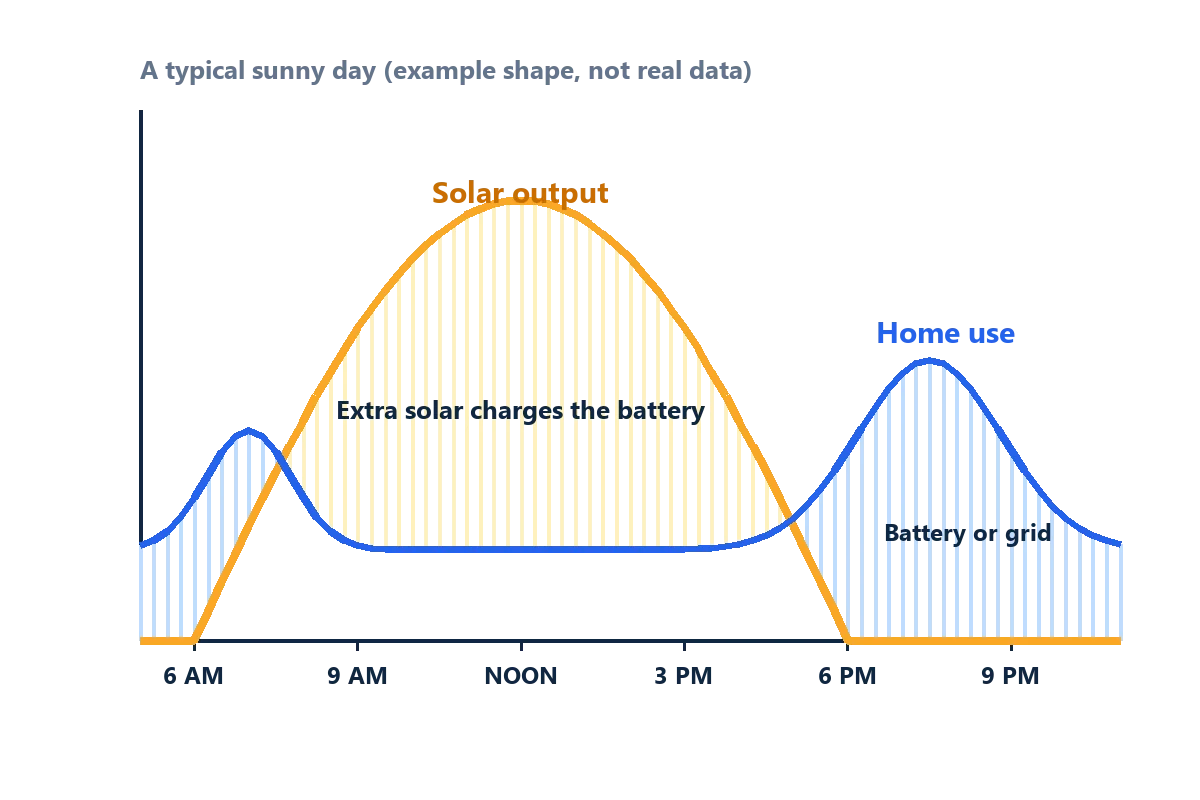
The easiest way to see how solar panels work at home is to follow one day. Here is a typical hybrid system, with panels, an inverter and a battery, connected to the grid.
Step 1: Early morning: a slow start
At sunrise the light is weak. The house still draws from the battery or the grid for breakfast and the rice cooker.
Step 2: Mid-morning: solar takes over
As the sun climbs, the inverter feeds the house first, then sends any extra to charge the battery.
Step 3: Noon to early afternoon: the peak
The strongest stretch of the day, and the best time for the washing machine, pump or aircon. With the battery full, extra power goes to the grid (with net metering) or the inverter holds production back.
Step 4: Late afternoon to evening: the hand-off
Output fades as the sun drops. By sunset the battery runs the lights, fans and TV until it reaches its set low level, then the grid supplies the rest.
Step 5: Brownout: what keeps running
If the grid goes down, a hybrid inverter switches to battery and solar for the circuits wired to its backup output. A grid-tied system with no battery shuts down instead, even in full sun, to protect line workers.
kW vs kWh in plain words
Two units cause the most confusion when people learn how solar panels work. A kilowatt (kW) is power: how fast energy is used or made at one moment. A kilowatt-hour (kWh) is energy: how much was used or made over time. Your electric bill charges you per kWh.
Think of water: kW is how wide the faucet is open; kWh is how many buckets you filled.
Example: an aircon drawing 800 W for 8 hours uses 800 W × 8 h = 6,400 Wh, which is 6.4 kWh.
Inverters are sized in kW (the most you run at once, plus start-up surge). Batteries and daily use are counted in kWh. To turn your own bill into these numbers, use our solar computation calculator; it shows every step.
DC to AC: the inverter’s job
No account of how solar panels work is complete without the inverter. Panels make DC, but your home runs on AC. The inverter switches the DC back and forth very quickly to build AC at the right voltage. It also:
- Finds the best operating point. MPPT (maximum power point tracking) keeps the panels at their most productive as light and heat change.
- Manages the battery in hybrid and off-grid systems.
- Protects the grid. A grid-tied inverter shuts down during a brownout so it does not send power into lines that workers may be repairing.
The US Department of Energy’s inverter basics go deeper on the grid side. For choosing and sizing one for a Philippine home, read our solar inverter guide.
Where batteries fit
A key point in how solar panels work is that panels store nothing. A battery saves extra daytime energy and gives it back at night or during a brownout. Most new home batteries use LiFePO4 (lithium iron phosphate), which handles deep daily cycling better than lead-acid.
A battery is not required for solar to cut your bill, but it is required for backup. How much you need depends on what you want to run and for how long. Our solar battery guide walks through usable versus nominal kWh and how to size for brownouts.
Grid-tied, hybrid and off-grid
The same panels can be part of three kinds of system. Which one you choose changes how solar panels work in your daily life, especially during a brownout.
| System | Main parts | Works in a brownout? | Good for |
|---|---|---|---|
| Grid-tied | Panels, grid-tie inverter, utility meter | No; it shuts down for safety | Cutting daytime use where the grid is reliable |
| Hybrid | Panels, hybrid inverter, battery, grid | Yes, for circuits on the backup output | Lower bills plus backup during brownouts |
| Off-grid | Panels, charge controller or inverter-charger, battery | Not affected; there is no grid connection | Farms, remote homes, small DIY setups |
An all-in-one unit puts the hybrid inverter and battery in one cabinet; it works like the hybrid row.
To see how the parts connect in each case, open our solar setup diagram guide. It has simple drawings for off-grid, hybrid and grid-tied systems.
Common myths
A lot of advice about how solar panels work is passed around online and between neighbors. Some of it is wrong. Here are the myths we hear most.
| Myth | What is true |
|---|---|
| “Panels need heat to work.” | They need light. Heat lowers output; a cool, bright day is ideal. |
| “Solar works in a brownout.” | Only with a battery and a hybrid or off-grid inverter. A grid-tied system without a battery shuts down. |
| “More panels are always better.” | The inverter, roof space, budget and your actual use set limits. Extra panels may produce power nobody uses. |
| “Panels store energy for the night.” | Panels store nothing. A battery or the grid covers the night. |
| “Solar means no more electric bill.” | Results depend on your use, system size and habits. Most homes still use some grid power. |
| “Panels never need attention.” | They need occasional cleaning, checks after storms and a look at the inverter app. |
Benefits and limits
Once you know how solar panels work, the strengths and weaknesses make sense.
Benefits
- Makes electricity from sunlight with no fuel, no engine noise and no fumes.
- Can lower the kWh you buy from your utility, mostly during the day.
- With a battery, keeps chosen circuits running through brownouts.
- No moving parts in the panels, so day-to-day upkeep is light.
Limits
- No production at night, and much less on cloudy days.
- Upfront cost, especially once a battery is added.
- Needs an unshaded roof that is strong enough and mounted for typhoon winds.
- Grid connection and net metering need permits and paperwork.
Solar in the Philippines
How solar panels work does not change by country, but local conditions shape the results. The overview of solar power in the Philippines is a good background read. Here is what matters for a home.
- Sun. Peak sun hours of about 3.5–5 a day are good for solar, though they vary by province and drop in the rainy season.
- Brownouts. Many areas see frequent outages, which is why hybrid systems with batteries are popular here.
- Heat. Hot roofs from March to May trim output.
- Typhoons. PAGASA issues tropical cyclone wind signals. Mounting must suit local wind loads, and the array should be inspected after every storm.
- Grid rules. Meralco and electric cooperatives handle net metering. Rules change, so check the current requirements with your utility (as of October 2026).
At JH Solar, we offer two all-in-one systems that combine a hybrid inverter and battery in one cabinet. JH Solar Version 1 uses 6 × 620 W panels and JH Solar Version 2 uses 14 × 720 W panels. Compare both on our Version 1 and Version 2 page; the price is confirmed after a site assessment.
On your phone
- Open the Global Solar Atlas on your phone, tap your barangay, and screenshot the solar figures.
- Save this page so you can check how solar panels work while you read a quote.
- Use your phone’s compass app on the roof or in the yard to see which way each roof side faces.
- Take photos of your roof at 9 a.m., noon and 3 p.m. to spot shade from trees, tanks or walls.
- Already have solar? Compare the inverter app at noon on a clear day and a cloudy day.
Safety and Electrical Reminders
- A solar panel makes voltage the moment light hits it, even when it is unplugged. Treat every panel cable as live in daylight.
- Panels in series add up to high DC voltage. Never disconnect a connector while current is flowing.
- Clean panels from the ground with a hose or soft brush when you can. Wet roofs are slippery, especially metal sheets.
- Wiring to your panel board, the grid connection and net metering are jobs for a registered master electrician or professional electrical engineer.
- Keep people off the roof during typhoons. If anything looks loose after a storm, have the mounting checked.
Solar panels make DC power whenever light hits them, and batteries hold enough energy to start a fire if they are shorted. Work on the grid side, the AC panel board or a net-metered system belongs to a licensed electrical practitioner following the Philippine Electrical Code. Our numbers are estimates, not a design or a quote.
Frequently Asked Questions
Do solar panels make any power from moonlight or streetlights?
Technically a tiny amount, but nothing useful for a home. Moonlight is reflected sunlight and is far too weak, and a streetlight only lights a small patch. In practice your panels produce from about sunrise to sunset, and anything you use at night comes from a battery or the grid.
Do solar panels store electricity by themselves?
No. A panel turns light into electricity the moment the light hits it, and it has nowhere to keep that energy. If nothing uses or stores the power, the system simply makes less. Storage needs a separate battery, either a stand-alone unit or one built into an all-in-one cabinet.
Why are solar panels tilted instead of lying flat on the roof?
A tilt points the panel more directly at the sun over the year and lets rain run off, which washes away some dust and leaves. Completely flat panels collect dirt and puddles at the frame edge. Near the equator a modest tilt is enough, and the roof pitch often decides it anyway.
Can one shaded panel pull down the whole system?
It can. Panels wired in series share one current, so a shaded panel can hold back the others in that string. Bypass diodes inside the panel and half-cut cell designs reduce the loss, and some systems use optimizers or extra MPPT inputs. The best fix is to avoid shade when planning the layout.
Is the electricity from solar panels different from the power Meralco supplies?
Panels make direct current (DC), which most home appliances cannot use. The inverter converts it into alternating current (AC) at the voltage and frequency your house wiring expects. After that point your appliances cannot tell whether the power came from the roof, the battery or your utility.
Why does my inverter show less power than the total rating of my panels?
Panel ratings are measured in lab conditions: strong, steady light and cool cells. On a real roof, heat, dust, wiring, the sun angle and inverter conversion all take a share. Seeing well below the rated total is normal. Compare the readings with your installer’s estimate for the same season instead.
Conclusion: from sunlight to your sockets
Now you know how solar panels work: light frees electrons in silicon cells, the cells make DC, and the inverter turns it into AC. Output follows the sun, rising toward noon, dropping with heat, shade and clouds, and stopping at night. A battery covers the evening and brownouts, and the system type decides what happens when the grid goes down.
Knowing how solar panels work makes a quote much easier to read. Start by turning your bill into kWh, then compare system types and sizes with your needs. When you are ready to talk about your roof, we are happy to help.
Put the basics to work
Turn your electric bill into a system size, then see how our all-in-one systems fit.
Related Guides
- JH Solar HomeStart here: JH Solar systems and every guide on one page.
- Types of Solar PanelsMono, poly, bifacial, flexible: which panel suits your roof.
- Solar Inverter GuidePick and size the box that turns solar DC into home AC.
- Solar Battery GuideHow much battery you need for nights and brownouts.
- Solar Setup DiagramRead any solar diagram and pick the setup that fits you.