
JH Solar Version 2: 11 kW, 15.36 kWh All-in-One Solar Unit
Last checked · JH Solar guide
JH Solar Version 2 is our larger all-in-one solar unit: an 11 kW hybrid inverter, two MPPT solar inputs and a 15.36 kWh LiFePO4 battery in one cabinet on casters. The unit price is ₱150,000. It is built for homes with aircon, bigger families and small businesses that want solar to carry the day and the battery to carry the night.
Below you will find the full ratings, how the dual MPPT inputs take up to 14 or 16 panels, how many panels you need for your goal, what it can run, and how it is wired, placed and ordered. Worked examples are labelled “Example” and show their math.
What JH Solar Version 2 Is
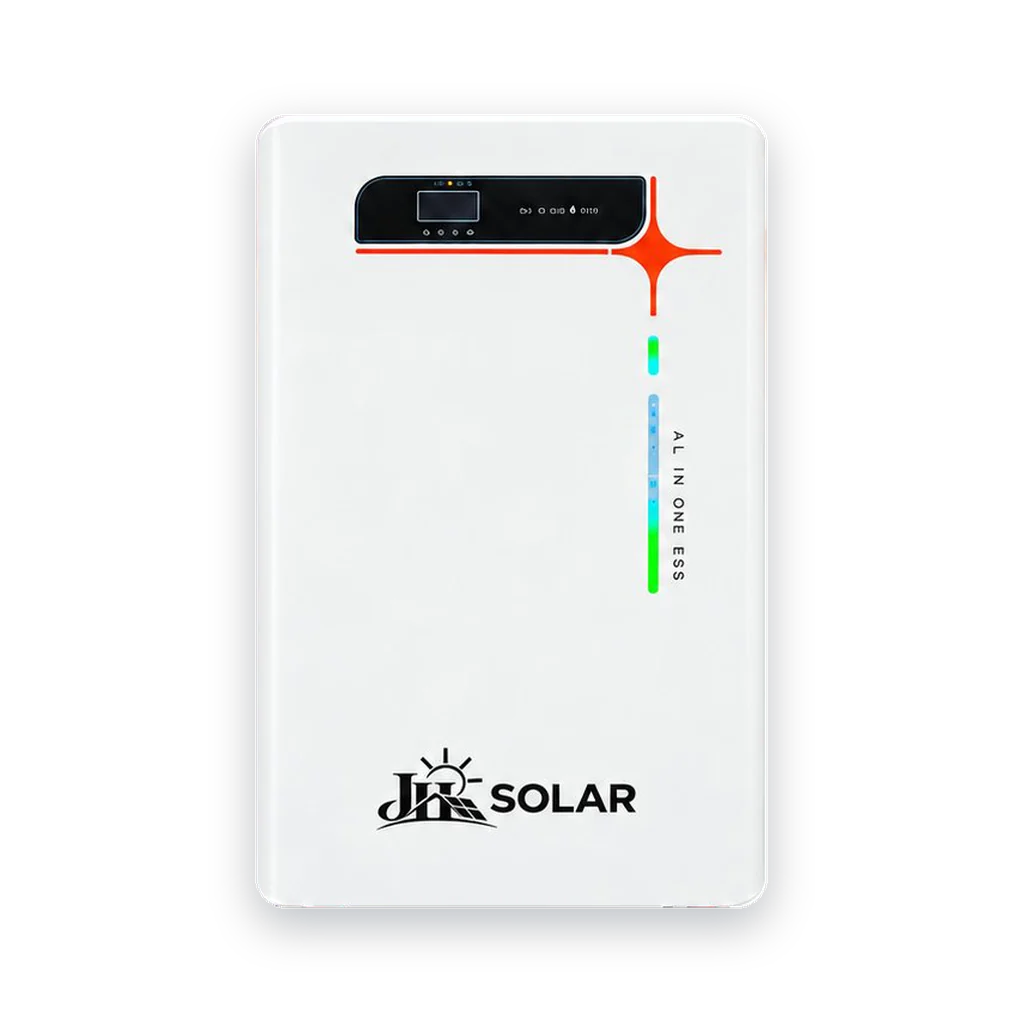
JH Solar Version 2 puts a hybrid inverter, a dual MPPT solar charger, a battery management system and a lithium iron phosphate battery in one cabinet. There are no separate battery racks or external battery cables, and the parts inside are already matched to each other.
It is plug-and-play in that sense, and it is a floor-standing unit that rolls on casters, a big step up from a hand-carry power station. The panels go on your roof, and a licensed electrician connects the unit to your panel board. Our side-by-side comparison of both JH Solar units shows how it differs from the smaller model.
The unit is rated off-grid capable, so it runs with or without grid power. With Meralco or your electric cooperative connected, it can use solar first and lean on the grid when the battery is low. During a brownout, the loads on its output keep running from the battery and the panels.
Who JH Solar Version 2 Suits
JH Solar Version 2 suits homes where solar has to do real work during the day as well as cover nights. The two solar inputs and the 11 kW inverter are what set it apart.
- Aircon homes: one or more inverter-type aircon units used in the afternoon and evening.
- Bigger households: several bedrooms, a washing machine, a water pump and more people home in the daytime.
- Home offices and small shops: computers, a chiller or freezer and lights that need to keep running through outages.
- Roof space for 14 or more panels: the unit gets the most from a large array.
If your use is lighter and backup at night is the main goal, the smaller JH Solar Version 1 with its 16.38 kWh battery may be enough. To check which side of the line you are on, compute your daily kWh from your bill first.
JH Solar Version 2 Price: ₱150,000 for the Unit
Unit price
₱150,000
Unit only; panels, mounting, wiring, labor and permits are quoted after a site assessment.
So, magkano? The unit is ₱150,000. That covers the cabinet with the 11 kW inverter, both MPPT inputs and the 15.36 kWh battery. The panels, mounting, cables, protection devices, labor and permits depend on your roof and wiring, so we quote them after a site assessment.
Full Specifications
These are the rated figures for JH Solar Version 2. Keep them handy when you read your quote.
| Item | Rating |
|---|---|
| Type | All-in-one: inverter + dual MPPT solar charger + LiFePO4 battery in one cabinet |
| Inverter output | 11 kW rated, 230 V AC, pure sine wave |
| Transfer time | 10 ms |
| AC input | 230 V nominal (90–280 V range), 60 A rated, 120 A max |
| Battery | 15.36 kWh nominal, 51.2 V, 300 Ah, LiFePO4 |
| Battery voltage range | 43.2–58.4 V |
| Battery charge / discharge current | 100 A standard charge, 200 A max charge, 200 A max discharge |
| Depth of discharge | 95% |
| Cycle life | At least 8,000 cycles to 80% capacity (25 °C, 0.5C) |
| Solar input | 2 MPPT × 5,500 W = 11,000 W max PV input |
| PV voltage | 120–500 V range, 300–400 V optimum, 500 V max |
| Max charging current (inverter) | 160 A |
| Communication | RS232 (inverter), RS485 / CAN (battery) |
| Operating temperature | Charge 0–50 °C, discharge −20–60 °C |
| Size | 57 × 40 × 78 cm (W × D × H) |
| Weight | About 160 kg |
| Typical array | 14 × 720 W = 10.08 kWp (7 + 7) or 16 × 620 W = 9.92 kWp (8 + 8) |
Battery kWh is nominal; the energy that reaches your appliances is lower (see the examples below).
The BMS is the battery’s guard: it watches cell voltage, current and temperature and cuts off when something goes out of range. The cycle rating tells you how many full charge and discharge cycles the LiFePO4 battery is rated for before its capacity falls to 80%, measured in lab conditions.
Dual MPPT Explained: How JH Solar Version 2 Takes 14 or 16 Panels
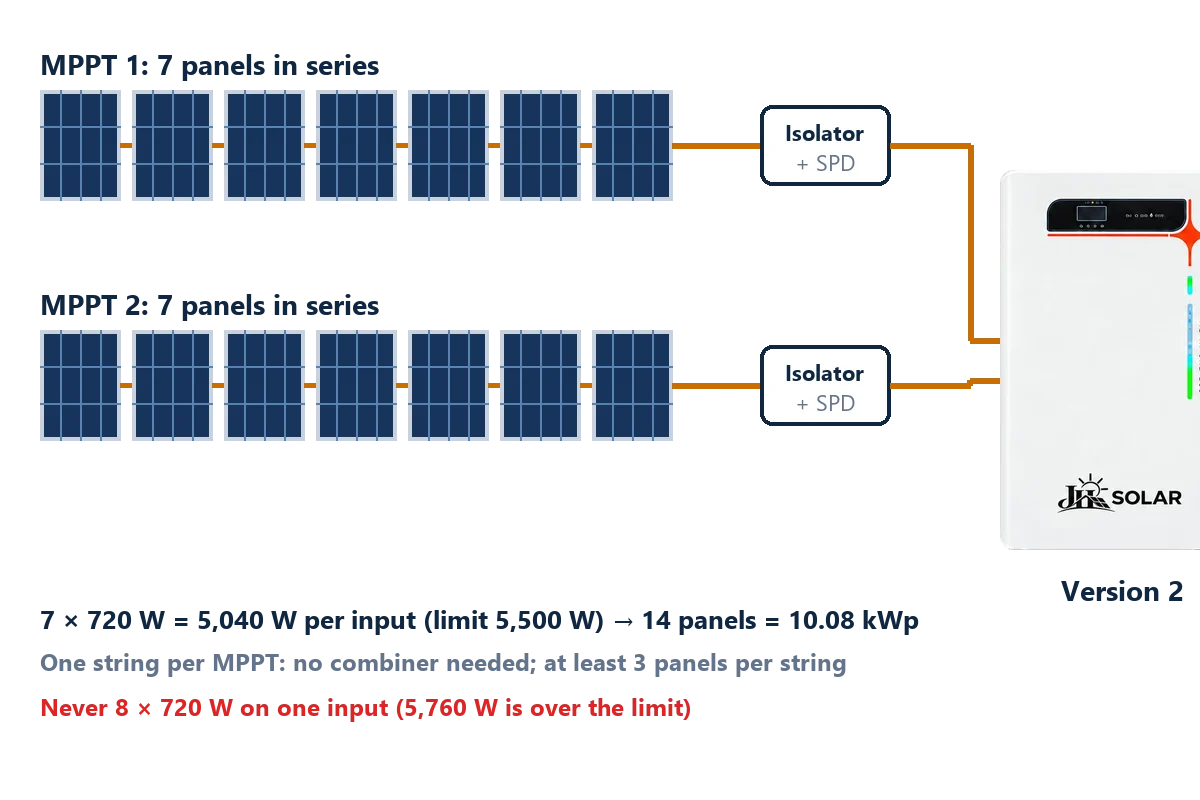
JH Solar Version 2 has two independent solar inputs, each with its own MPPT. Each input accepts up to 5,500 W of panels, works between 120 V and 500 V, and must never see more than 500 V open-circuit. The US Department of Energy’s inverter basics page is a good primer on how inverters and trackers handle solar power.
One string per MPPT
Each input takes one string of panels in series. Two inputs also help when your roof has two faces: one string can face east and the other west, and each tracker finds the best point for its own string.
At least three panels per string
A string must stay above 120 V to keep the tracker working. Our 620 W panel runs at 41.3 V, so three in series give about 123.9 V, just above the floor, while two would give only 82.6 V. At the top end, eight 620 W panels reach about 388.8 V open-circuit, well under the 500 V limit.
Never eight 720 W panels on one input
Power is the other limit. Seven 720 W panels give 5,040 W per input, which fits under 5,500 W. Eight would give 5,760 W, which is over the rating, so that layout is never used.
| Layout | Per MPPT | Total array | Fits? |
|---|---|---|---|
| 14 × 720 W (standard package) | 7 × 720 W = 5,040 W | 10.08 kWp | Yes |
| 16 × 620 W | 8 × 620 W = 4,960 W | 9.92 kWp | Yes |
| 16 × 720 W | 8 × 720 W = 5,760 W | 11.52 kWp | No: over 5,500 W per MPPT |
| 2 panels in a string | Under 120 V working voltage | — | No: below the MPPT window |
The 720 W panel's electrical data is confirmed with your quote. Your installer also checks each string against the input's current limits in the manual.
How Many Panels for a 3-Hour Peak: Examples
How many panels JH Solar Version 2 needs depends on your goal. The examples below use our own sizing method: a 3-hour strong-sun window and 20% losses from heat, wiring and conversion, so required panel watts = target power ÷ 0.8.
| Example goal | Example math | With 620 W panels | With 720 W panels |
|---|---|---|---|
| Charge at about 4 kW | 4,000 W ÷ 0.8 = 5,000 Wp | 8 panels (4,960 Wp) | 7 panels (5,040 Wp) |
| Full recharge of about 15 kWh | 15,000 Wh ÷ 3 h = 5,000 W; ÷ 0.8 = 6,250 Wp | about 10–11 panels | 9 panels (6,480 Wp) |
| Full recharge + 2 kW daytime load | (5,000 W + 2,000 W) ÷ 0.8 = 8,750 Wp | about 14 panels | 13 panels (9,360 Wp) |
Examples only. Real output depends on your location, roof angle, shade, heat and season; the site assessment sets the final count.
Example of a full sunny day: 10.08 kWp × 4 peak sun hours × 0.75 overall factor ≈ 30.2 kWh from the standard package. Part of that runs your daytime appliances directly, and part refills the battery.
The 160 A charging limit and clipping
The unit can put at most 160 A into the battery. Example: 160 A × 51.2 V ≈ 8,192 W, about 8.2 kW. With 20% losses that matches about 8,192 W ÷ 0.8 ≈ 10.2 kWp of panels, so above about 14 panels of 720 W, midday output can be more than the battery can take while the house is not using it. The unit then takes less from the panels, which is called clipping. It is normal and safe, and the extra panels still pay their way in the morning, late afternoon and on cloudy days.
What JH Solar Version 2 Can Run, Including Aircon
Two checks decide what JH Solar Version 2 can run. Power: the total watts running at the same moment, plus motor start-up surge, must stay under 11 kW. Energy: watts × hours for each appliance, divided by 1,000, gives the kWh the battery and panels must cover.
| Example load | Example watts × hours | Example energy |
|---|---|---|
| 1HP inverter aircon (average draw) | 800 W × 8 h | 6.4 kWh |
| Inverter-type refrigerator (average) | 100 W × 12 h | 1.2 kWh |
| LED lights (10 bulbs × 10 W) | 100 W × 6 h | 0.6 kWh |
| Three electric fans | 180 W × 8 h | 1.44 kWh |
| TV and Wi-Fi router | 115 W × 5 h | 0.58 kWh |
| Example total | — | ≈ 10.2 kWh |
Example wattages only. Use the labels on your own appliances; real draw changes with settings, heat and age.
Example: the battery delivers about 15.36 kWh × 0.8 usable × 0.9 efficiency ≈ 11.06 kWh to your appliances, or about 11 hours at a steady 1 kW. The night above fits, with a small margin. A second aircon running all night would not, so plan which rooms stay cool after dark.
In the daytime the picture changes. With 14 panels in strong sun, the array can carry one or two aircon units directly while still charging the battery. For deeper aircon sizing, including 1.5HP and 2HP units, read our guide to running an aircon on solar panels. See how solar inverters are sized if a pump or old aircon trips the output on start-up surge.
Typical Wiring Summary
A Version 2 install follows this pattern. It is here to help you read your quote, not to replace a licensed electrician.
- Panels: one string per MPPT input, 7 + 7 for the standard 14-panel package, with mounting rated for local wind.
- DC isolator per string: a switch on each string so either side can be shut off for service.
- Surge protection per string: a DC surge protective device on each solar line, for thunderstorm season.
- AC breaker: sized from the rated output current of about 47.8 A at 230 V. A 63 A 2-pole breaker is a typical starting point, confirmed by your electrician against the manual and the Philippine Electrical Code, together with the cable size.
- Grounding: panel frames, rails and the cabinet bonded to a proper ground.
Because each input takes a single string, there is no parallel combining of strings on the roof side. Your electrician follows the manual for any further fusing and labels every switch.
Placement: Size, Weight and a Level Floor
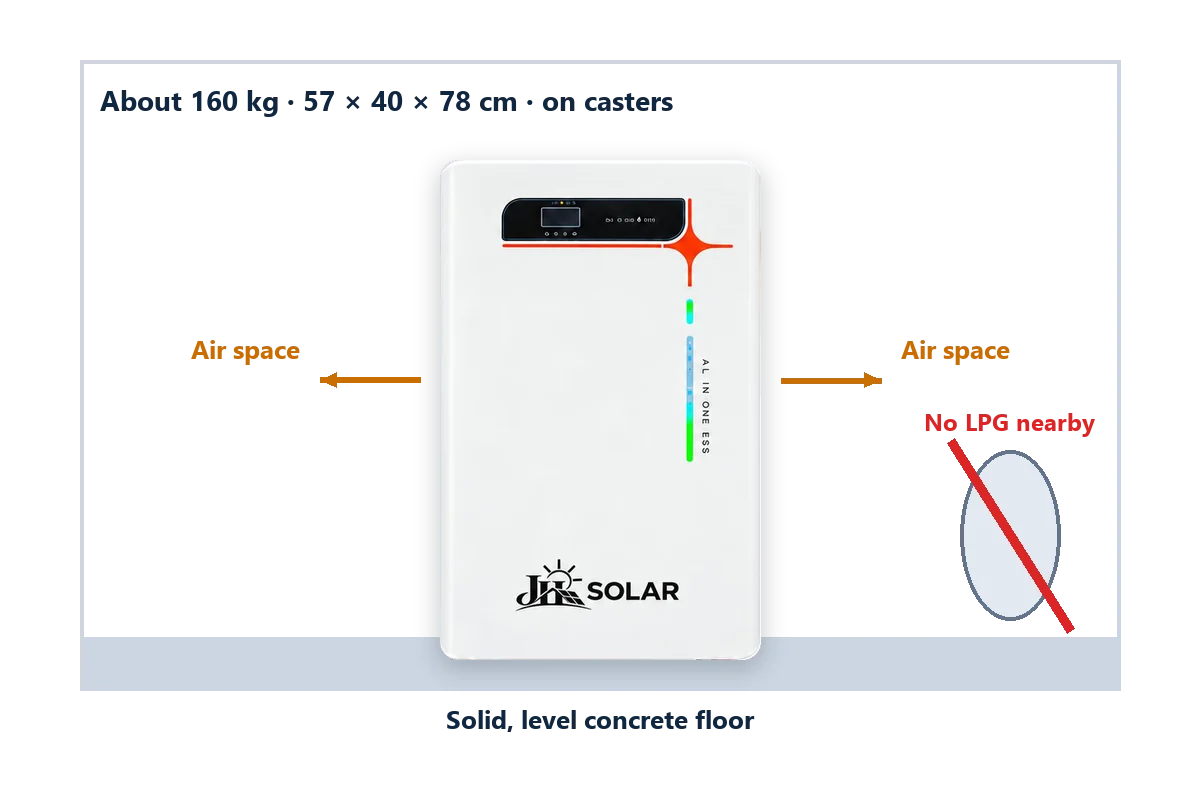
The cabinet measures 57 × 40 × 78 cm (W × D × H) and weighs about 160 kg. It rolls on casters, so it needs a solid, level floor, such as a concrete slab, that can carry the weight without flexing.
- Floor: solid and level; avoid weak wooden floors and sloped garage ramps.
- Ventilation: shaded and dry, out of direct afternoon sun, with open space around it as the manual specifies.
- Flood level: above the highest water your street has seen; raise it on a solid base if needed.
- Away from LPG: keep it away from LPG tanks, the kitchen, fuel, paint and anything that burns easily.
- Getting it in: measure doors, hallways and any steps on the way in before delivery day.
Philippine Conditions and Tips on Your Phone
Peak sun hours in the Philippines are typically about 3.5 to 5 a day, depending on place and season; check your own city on the Global Solar Atlas. In the rainy season the array may only partly refill the battery, so the grid input and load planning matter more.
Hot afternoons trim panel output and push up aircon use at the same time, which is one reason the larger array helps. Typhoon season calls for mounting that suits local wind and a check after any strong storm.
On your phone
- Before you photograph your bill, hide your name, address and Customer Account Number (CAN); add a few past months if you have them.
- Take daylight photos of each roof face and of the floor spot for the cabinet.
- Photograph the label of every aircon you want on the backup output.
- Save the quote, warranty terms and shutdown steps in one folder.
How to Order JH Solar Version 2
Ordering JH Solar Version 2 takes five steps, and nothing is final until you accept a written quote.
Step 1: Compute your needs
Use the solar computation tool with your bill to see your daily kWh and a rough panel count.
Step 2: Send your bill
Hide your name, address and Customer Account Number (CAN) before you take the photo; we only need the kWh used, the billing period and the amount. Then send the bill photo, your city or barangay and the loads you want backed up, through the form on our contact page or on Messenger.
Step 3: Site assessment
We check both roof faces, shade, the floor for the cabinet, the distance to your panel board and your wiring.
Step 4: Written quote
You get the unit, panel count and layout, parts list, price and warranty coverage in writing.
Step 5: Installation
Licensed electricians install the panels, protection devices and unit, test it, and walk you through it.
Questions before you start? Our contact page for quotes and site assessments lists what to send and what happens next.
Payment Methods and Warranty
Payment methods we accept: Bank transfer, GCash, Maya, Cash. The payment terms for your order are written into your quote, so you know what is due and when before you pay. Keep every receipt with the quote.
Version 2 comes with a 10-year hardware warranty; the exact coverage is written into your quote. Before you sign, ask what parts are covered, how a claim is made, and who you call if the display shows an error.
JH Solar Version 2 Customer Reviews
No published reviews yet.
We publish reviews only from real JH Solar customers, with their permission, after their system has been running for a while. Already have a JH Solar Version 2? Write a review with the form below or share it on our Facebook page.
JH Solar on FacebookCustomers can share their own review with the form above; each review appears on this page after JH Solar checks it.
Safety and Electrical Reminders
- Do not open the cabinet. The battery stays live even when the grid and the panels are off.
- Never put eight 720 W panels on one input, and never let a string go over 500 V open-circuit.
- Switch off both DC isolators before anyone touches the panel wiring.
- Move the 160 kg cabinet only after shutdown and disconnection, with enough people, on a level floor.
- After a flood or typhoon, do not touch wet equipment. Have a licensed electrician check the system before it is switched back on.
Solar panels make DC power whenever light hits them, and batteries hold enough energy to start a fire if they are shorted. Work on the grid side, the AC panel board or a net-metered system belongs to a licensed electrical practitioner following the Philippine Electrical Code. Our numbers are estimates, not a design or a quote.
Frequently Asked Questions
How many aircon units can JH Solar Version 2 run at the same time?
The 11 kW inverter has room for two or three inverter-type 1HP units running together with a fridge and lights, as long as the start-up surges stay within its limits. The battery decides how long. Example: two aircon units averaging 800 W each for 8 hours use 12.8 kWh, more than the roughly 11 kWh the battery delivers, so two all night from the battery alone will not last.
Why can one MPPT on Version 2 not take eight 720 W panels?
Each of the two MPPT inputs is rated for 5,500 W of panel power. Eight 720 W panels add up to 5,760 W, which is over that rating. Seven 720 W panels give 5,040 W, which fits, so the 14-panel package is split 7 + 7. With 620 W panels, eight per input is fine because 8 × 620 W is 4,960 W.
What does the 8,000-cycle rating of Version 2 mean in real life?
One cycle is roughly one full charge and discharge. The battery is rated for at least 8,000 cycles before it falls to 80% of its original capacity, measured in lab conditions. In a home, heat, how deep you drain it each night and the age of the cells all affect real life, so treat the cycle figure as a quality marker and rely on the written warranty terms.
Is the ₱150,000 Version 2 price for the whole 14-panel system?
No. ₱150,000 is the price of the all-in-one unit only: the cabinet with the 11 kW inverter, dual MPPT charger and 15.36 kWh battery. The 14 panels, mounting, PV cables, protection devices, labor and permits are quoted after a site assessment, because each roof and wiring run is different. The quote lists every item before you agree.
Can Version 2 be moved to another room after it is installed?
The cabinet rolls on casters, so it can be moved on a level floor, but it weighs about 160 kg and is wired to the panels and your panel board. Moving it means shutting the system down and having a licensed electrician disconnect and reconnect it. Stairs need extra people and planning, so choose the final spot carefully during the site assessment.
Why does Version 2 output flatten at midday when there are many panels?
The unit can push at most 160 A of solar charging into the battery, about 8.2 kW (160 A × 51.2 V). With more than about 14 panels of 720 W, the panels can produce more than that at noon when the house is not using the extra. The unit simply takes less, which is called clipping. It is normal, and the extra panels still help in the morning, late afternoon and on cloudy days.
Conclusion: Is JH Solar Version 2 Right for Your Home?
JH Solar Version 2 combines an 11 kW inverter, two MPPT inputs and a 15.36 kWh battery in one cabinet on casters, for ₱150,000, unit only. Its dual inputs take 14 × 720 W or 16 × 620 W panels, which lets solar carry aircon and daytime loads while the battery covers the evening.
Pick your goal from the sizing examples, check your night loads against the battery example, and send us your bill for a site assessment. You can also explore everything else JH Solar offers on the homepage.
See if Version 2 fits your home
Compute your daily kWh from your bill, then send it to us for a site assessment and a written quote.
Related Guides
- JH Solar HomeStart here: JH Solar systems and every guide on one page.
- JH Solar ProductsOur two all-in-one units, side by side.
- JH Solar Version 17 kW and 16.38 kWh in one unit for smaller homes.
- Solar ComputationTurn your electric bill into a system size in a few taps.
- Contact JH SolarAsk for a quote or a site assessment.
- Solar Panel for AirconRun your aircon on solar: panels, battery and inverter.