
Best Solar Installers in the Philippines: How to Choose, Plus Budget Options
Last checked · JH Solar guide
Searching for the best solar installers in the Philippines usually means you are close to spending real money on your roof. The trouble is that every provider calls itself the best. This guide gives you a way to judge any installer yourself, using licenses, written warranties and after-sales service instead of ads.
You will find the main types of solar companies in the Philippines, a checklist, questions to ask, red flags in quotes, budget-friendly ways to start, a side-by-side table of 15 established installers, and an honest DIY vs installer comparison.
What the Best Solar Installers Do Differently
People look for the best solar installers because a solar system is only as good as the person who designs and mounts it. Good panels on a weak roof mount, or a battery wired without proper protection, can fail in the first typhoon season. The installer also handles permits and paperwork with your utility.
The best solar installers share a few habits. They visit your site before quoting, ask for your electric bill, put a licensed electrician on the job and explain what happens when something breaks. None of this depends on company size.
Hiring one of the best solar installers brings a design matched to your bill, legal paperwork and a workmanship warranty. The trade-offs: labor and permits add cost, and you depend on the company staying in business.
Types of Solar Companies in the Philippines
Not every seller is an installer. Before you compare the best solar installers, know which kind of provider you are talking to.
| Provider type | What they do | Good for | Watch out for |
|---|---|---|---|
| Full-service installer (EPC) | Design, supply, installation, permits and after-sales | Homeowners who want one party responsible for everything | Check that the warranty covers both parts and workmanship |
| Equipment seller or distributor | Sells panels, inverters and batteries; may refer you to an installer | Installers and experienced buyers | No one may be responsible for design or installation errors |
| DIY kit seller | Sells boxed kits, often online, with basic instructions | Small DC systems for lights, fans and charging | Grid-tied or AC panel work still needs a licensed electrician |
| All-in-one system brand | A cabinet with the hybrid inverter and battery inside, plus panels | Homes that want backup with fewer separate parts | Ask who services the unit and how fast |
| Lease or rent-to-own provider | Installs the system and charges a monthly fee over a contract | Homes that cannot pay the full amount upfront | Higher total cost, ownership terms and early exit fees |
Many companies mix these roles, so ask which parts of the job they do themselves.
Checklist: How to Judge a Solar Installer
Use this checklist on every provider. The best solar installers tick every box and put the answers in writing.
- A licensed electrician on the job. A registered master electrician (RME) or professional electrical engineer (PEE) should design or supervise the electrical work, following the Philippine Electrical Code published by the Institute of Integrated Electrical Engineers (IIEE). Ask for the name and license number.
- Permits and paperwork. The LGU electrical permit, the Certificate of Final Electrical Inspection (CFEI) and, if you want it, the net metering application.
- Written warranty for parts and workmanship. You need both on paper.
- Clear equipment details. The quote should state the system size, battery size and what each part is rated for; ask for model numbers if you want to look them up.
- After-sales service. Ask who you call when the inverter shows an error, and how many days a technician visit takes.
- Past projects you can verify. Recent photos or a past client you can talk to.
- Mounting built for typhoon winds. Which rails, clamps and roof anchors they use, and how they seal roof penetrations against leaks.
If you are still choosing equipment, our guide to the best solar panel brand checks for Filipino buyers explains datasheets, warranties and how to spot relabeled products.
Philippine factors: permits, net metering and typhoons
Net metering is under the Renewable Energy Act of 2008 (RA 9513). The Meralco net metering FAQ lists the documents, including the LGU electrical permit, the CFEI and an ERC Certificate of Compliance; electric cooperatives handle it for their members. Check the current requirements with your utility.
Typhoons are the other local test. The best solar installers will explain how the mount suits PAGASA tropical cyclone wind signals and inspect the system after a strong storm. Heat and rain matter too: inverters need shade and airflow, and every cable entry should stay dry.
Questions to Ask Before You Sign
Send these questions by message or email so you have the answers in writing. The best solar installers answer clearly; vague replies are useful information too.
| Question | A good answer includes |
|---|---|
| Who designs and signs the electrical work? | The name and license of the RME or PEE |
| What size system are you quoting, and why? | The kWp, battery kWh and the bill or load list it was based on |
| What exactly is included in the price? | Panels, mounting, wiring, protection, labor, permits and net metering fees, line by line |
| What warranties do I get, and from whom? | Equipment warranty terms plus a written workmanship warranty |
| Do you handle the permit, CFEI and net metering? | Yes, with a list of steps and who pays which fees |
| What happens if the inverter fails? | Who to call, typical response time and who handles the repair |
| What is the payment schedule? | Staged payments tied to delivery, installation and commissioning |
Red Flags in a Solar Quote
Most problems are visible in the quote before any work starts. Walk away, or at least slow down, if you see any of these:
- Vague sizing. No kWp, no battery kWh and no ratings means you cannot compare anything.
- Promises that your bill will vanish, or fixed savings. Your bill depends on usage, weather, rates and fixed charges. No honest installer can promise it disappears.
- Pressure tactics. “Promo ends today.”
- Full payment upfront. Staged payments protect you if the job stalls.
- No permit. An installer who says the permit is unnecessary puts your house, insurance and any net metering application at risk.
- No site visit. A quote made from a photo can miss shading, roof condition and panel board capacity.
On your phone: checking reviews and licenses
- Search the company name plus “complaint” or “review” and read posts outside the company’s own page.
- Ask for a photo of the electrician’s PRC ID and check that the name matches the quote.
- Check the dates on their project photos. Recent, varied jobs are a better sign than a few old pictures.
- Save every quote as a PDF in one folder so you can compare them side by side.
Budget-Friendly Solar Providers and Options
A budget plan is not about the cheapest installer. It is paying only for what you need now, without cutting safety. The best solar installers for a tight budget help you phase the project rather than sell the biggest package.
- Start grid-tied for daytime use. No battery means a simpler, cheaper system. The trade-off: a grid-tied inverter shuts down during a brownout to protect line workers, so you get no backup.
- Add a battery later, but only with a hybrid-ready inverter. Otherwise you may need a second inverter later.
- Consider an all-in-one unit. One cabinet with the inverter and battery means fewer separate parts.
- Use a small DC kit for brownouts. For lights, fans, a router and phone charging, a small kit costs far less than whole-home backup. Our off-grid solar setup guide shows a safe layout with fuses and breakers.
- Size from your real bill. Use the kWh on your bill and our solar computation calculator before you ask for quotes.
- Compare three quotes on the same kWp, then compare price per watt-peak.
Example only (made-up numbers): Quote A is ₱300,000 for 5 kWp: ₱300,000 ÷ 5,000 W = ₱60 per watt-peak. Quote B is ₱330,000 for 6 kWp: ₱55 per watt-peak. B costs more in total but less per watt.
| Option | Upfront cost | Backup in a brownout | Main trade-off |
|---|---|---|---|
| Grid-tied, no battery | Lower | No | Saves on daytime use only |
| Hybrid inverter, battery later | Medium now | Only once the battery is added | Inverter costs more than a grid-tied one |
| All-in-one system | Higher | Yes | Battery and inverter are serviced as one unit |
| Small DC kit | Lowest | Yes, for small DC loads | Does not run aircon or the whole house |
| Lease or rent-to-own | Low or none | Depends on the system | Higher total cost and contract terms |
“Lower” and “higher” compare these options with each other, not with any specific provider.
Financing and lease trade-offs
Financing, leasing and rent-to-own plans spread the cost, but you usually pay more in total. Read who owns the system during the contract, who pays for repairs, what happens if you move, and the cost of ending early.
Solar Installers in the Philippines Compared
Readers often ask for names to compare. The table lists 15 established solar companies in the Philippines with what each states on its own website. It is not a ranking of the best solar installers and it is far from complete; use it to build a shortlist.
| Company | Type | Head office / areas | Services mentioned on its website | Website |
|---|---|---|---|---|
| Ecoplus Solar Inc. | Installer and electrical contractor | Trece Martires, Cavite; also lists a Cebu site | Residential and commercial solar; EV chargers; solar street lights | ecoplus.ph |
| GoSolar Philippines | Solar engineering company, design to commissioning | Las Piñas City; projects in Rizal, Batangas, Bulacan and Cavite | Homes, businesses and industry; net metering help; hybrid systems; bank financing partners | gosolarphilippines.com |
| LakaSolar | Installer | Cebu City; lists areas in Luzon, Visayas and Mindanao | Residential and commercial; net metering applications; battery backup | lakasolar.ph |
| Meister Solar | Equipment seller and installer | Bamban, Tarlac | Home and corporate clients; net metering help; off-grid hybrid systems | meistersolar.ph |
| MSpectrum | Solar company of Meralco | Pasig City; inquiry form covers Metro Manila and nearby provinces | Home and business rooftop solar; hybrid or hybrid-ready; net metering and zero-export enrollment | mspectrum.com.ph |
| PHILERGY German Solar | Installer and component seller | Quezon City (head office and showroom) | Homes, businesses and industry; net metering service; financing options | philergy.com |
| Solar Up Philippines | Installer and EPC | Cagayan de Oro City; projects in Northern Mindanao and Cebu | Homes, businesses and industry; battery backup; net metering help; lease-to-own | solarup.ph |
| Solaready Philippines | Solar provider and distributor | Alabang, Muntinlupa | Homes, businesses and industry; grid-tie and off-grid systems | solaready.ph |
| Solaric Corp. | Installer; also sells equipment to installers | Pasig City (office and showroom); founded 2013 | Homes and businesses; net metering; batteries optional; solar training | solaric.com.ph |
| SolarNRG Philippines | Installer and EPC | Says it installs nationwide; set up in the Philippines in 2014 | Home grid-tied systems with net metering help; commercial lease-to-own; maintenance | solarnrg.ph |
| Solarpinoy (Philippine Pure Energy Solutions Inc.) | Installer; also makes steel poles | Quezon City | Solar installation for homes and businesses; grid-tie packages | solarpinoy.ph |
| Solenergy Systems Inc. | Engineering and EPC | Mabalacat, Pampanga | Commercial, utility-scale and off-grid; battery storage (no home offer on its homepage) | solenergy.com.ph |
| Solviva Energy | Home solar installer, part of AboitizPower | Makati City; Metro Manila and nearby provinces | Homes; zero-down rent-to-own (up to 60 months) or cash; hybrid-ready | solvivaenergy.com |
| SunTech Power | Installer | Talisay City, Cebu | Homes and businesses; hybrid systems; battery storage | suntech.ph |
| Unisolar Inc. | Installer and EPC | Quezon City; projects in Pampanga and Leyte | Homes, businesses and industry; grid-tie rooftop systems | unisolar.com.ph |
Listed alphabetically for reference only; no ranking, no paid placement, and no tie with JH Solar. Details are as stated on each company’s own website, as of October 2026. Check each company’s current details.
How to compare these installers
The best solar installers for your home are the ones that fit your location, job and budget. Four quick filters:
- Start with distance. Shortlist two or three that list your province. A team several islands away may be slow after a storm.
- Match the type to your job. A home system needs a company that does residential work; some firms above focus on commercial or utility-scale projects.
- Separate payment from quality. Lease-to-own and rent-to-own make solar easier to start, but compare the total paid over the contract with a cash price.
- Same size, same scope. Ask each one to quote the same kWp and battery size, with permits and net metering either included or excluded in all quotes.
What to ask each one
Send every company on your shortlist the questions table above, plus: Do your own crews cover my area? Is the workmanship warranty in the contract? Who handles net metering with my utility? Can I talk to a past client near me? The best solar installers answer in writing, which makes the comparison fair.

Where JH Solar Fits
JH Solar is not on the table above because we are not a neutral party. We sell all-in-one solar systems: the hybrid inverter and battery sit in one cabinet, and we add panels, mounting, wiring and installation after a site assessment. Unit prices are ₱120,000 for Version 1 and ₱150,000 for Version 2, unit only; panels, mounting, wiring, labor and permits are quoted after a site assessment.
Payment options: Bank transfer, GCash, Maya, Cash; the schedule is written into your quote. Want the component models listed? Ask us and we’ll list them. You can reach us on Facebook and Messenger. Compare both units on the JH Solar Version 1 and Version 2 page, or contact us for a site assessment. Use the same checklist on us that you use on anyone else.
DIY vs Hiring an Installer
For a small DC kit, careful DIY is possible. For anything connected to your house wiring or the grid, a licensed electrician is required, and that is where the best solar installers earn their fee: design, permits, safe wiring and someone to call later.
| Point | DIY | Installer |
|---|---|---|
| Best for | Small DC kits: lights, fans, phone charging | Grid-tied, hybrid and whole-home systems |
| Upfront cost | Lower, but tools and protection parts add up | Higher, includes labor, permits and design |
| Permits and net metering | Not possible for grid work | Handled by the installer with an RME or PEE |
| Safety risk | Higher if you skip fuses, breakers or grounding | Lower when the work follows the electrical code |
DIY on a small kit still needs fuses, DC breakers and grounding; call a licensed electrician before touching house wiring. Our solar panel installation guide walks through a proper install step by step.
Safety and Electrical Reminders
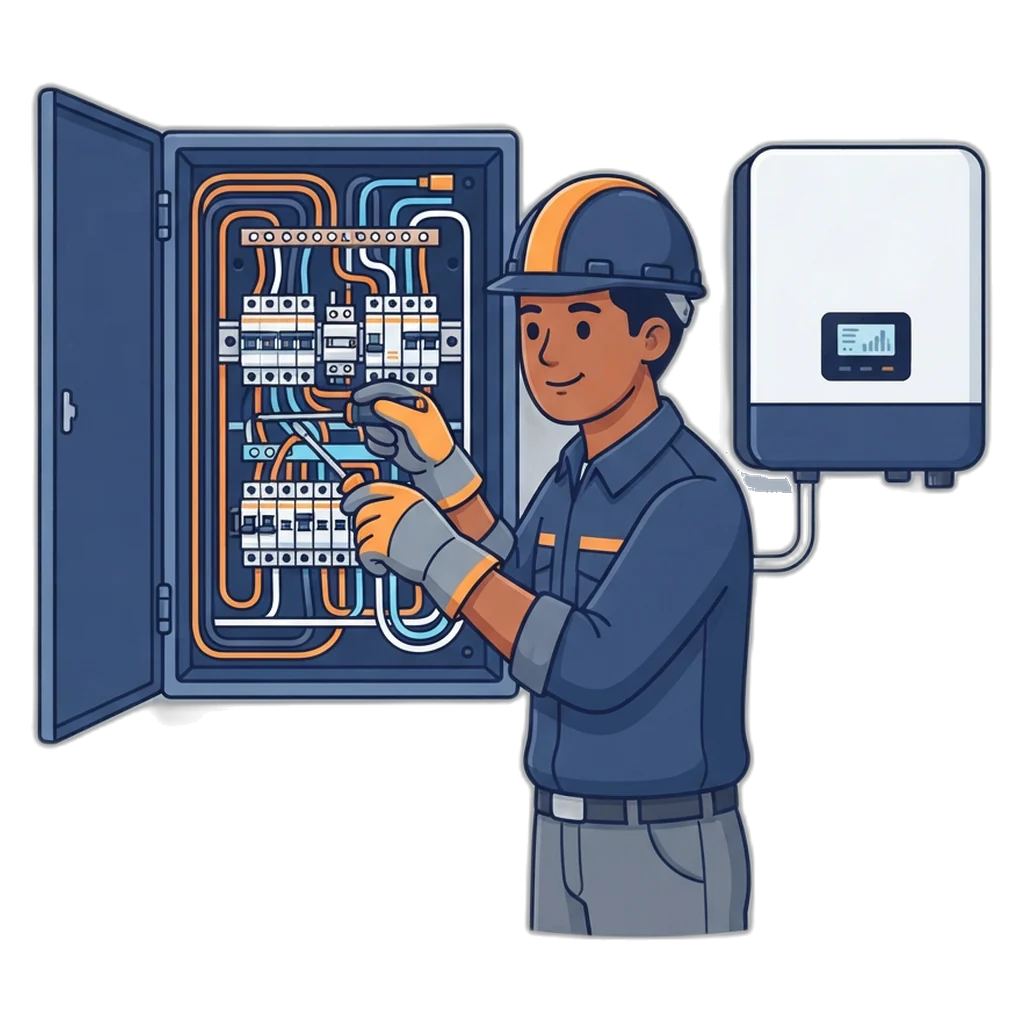
- Do not let anyone connect a solar inverter to your panel board or the grid without a permit and a licensed RME or PEE.
- Leave roof work to the crew. No one should work up there in rain or strong wind.
- The best solar installers will show you the DC and AC isolators and how to shut the system down in an emergency. Ask for this at handover.
- After a typhoon, check the array from the ground first. Call the installer if panels have shifted or cables are loose; do not climb up yourself.
The US Department of Energy’s homeowner’s guide to going solar lists more questions to ask the best solar installers before hiring.
Solar panels make DC power whenever light hits them, and batteries hold enough energy to start a fire if they are shorted. Work on the grid side, the AC panel board or a net-metered system belongs to a licensed electrical practitioner following the Philippine Electrical Code. Our numbers are estimates, not a design or a quote.
Frequently Asked Questions
How do I find a solar panel installer near me that I can trust?
Start with providers that can send someone to your area for a site visit, then check their licensed electrician, past projects and reviews outside their own page. The best solar installers are happy to share all three. Ask neighbors, your barangay or local electricians who they have seen do clean work. A nearby installer also matters for after-sales visits after storms.
Who is allowed to do the electrical work on a home solar system in the Philippines?
Electrical work on the AC side, the panel board and any grid connection is done by or under a registered master electrician (RME) or a professional electrical engineer (PEE), following the Philippine Electrical Code. The same people sign the documents needed for the LGU electrical permit and the final inspection.
What is the cheapest safe way to start with solar at home?
For many homes, a small grid-tied system sized for daytime use is the lowest-cost start, because it needs no battery. If brownouts are the main problem, a small DC kit for lights, fans and phone charging is cheaper than whole-home backup. Either way, keep proper protection and a licensed electrician for grid work.
Is a solar lease or rent-to-own plan worth it?
It can be if you cannot pay upfront, but the total you pay over the contract is usually higher than buying in cash. Read who owns the system, who pays for repairs, what happens if you sell the house and the cost of ending early. Compare the monthly fee against your actual bill, not an advertised saving.
Why do solar quotes for the same house differ so much?
Quotes often differ in system size, battery size, component models, mounting quality and what labor and permits are included. One quote may leave out net metering paperwork or surge protection. Ask every provider to quote the same kWp and battery size, then compare price per watt-peak and the warranty terms line by line.
What should an installer give me when the job is finished?
Ask for an as-built wiring diagram, the warranty documents, the serial numbers, the inverter app login, a copy of the permit and inspection papers, and a short guide to the breakers and shutdown steps. Keep everything in one folder with your receipt and contract so any technician can help you later.
Conclusion: Judge the Installer, Not the Ad
The best solar installers in the Philippines put a licensed electrician on the job, handle permits, quote a clear system size, give a written workmanship warranty and answer the phone when something breaks. Use the comparison table to build a shortlist, then run the checklist, the questions and the red flags on every name on it.
Budget solar is possible with the best solar installers too. Phase the project: start with daytime grid-tied use or a small DC kit, choose a hybrid-ready inverter if you plan to add a battery, and compare three quotes on the same kWp. Spending less is fine; cutting safety is not.
Get a quote you can check
Tell us about your home and your bill. We will do a site assessment and put the system size, price and warranty terms in writing.
Related Guides
- JH Solar HomeStart here: JH Solar systems and every guide on one page.
- Solar Panel InstallationWhat happens on install day, and what comes before it.
- Solar ComputationTurn your electric bill into a system size in a few taps.
- Best Solar Panel BrandsPanels, inverters and batteries: what makes a brand good.
- JH Solar ProductsOur two all-in-one units, side by side.